Interior Design
Conservatory At Melbourne’s Crown Towers’
French-Deco Industria And Old World Decadence.
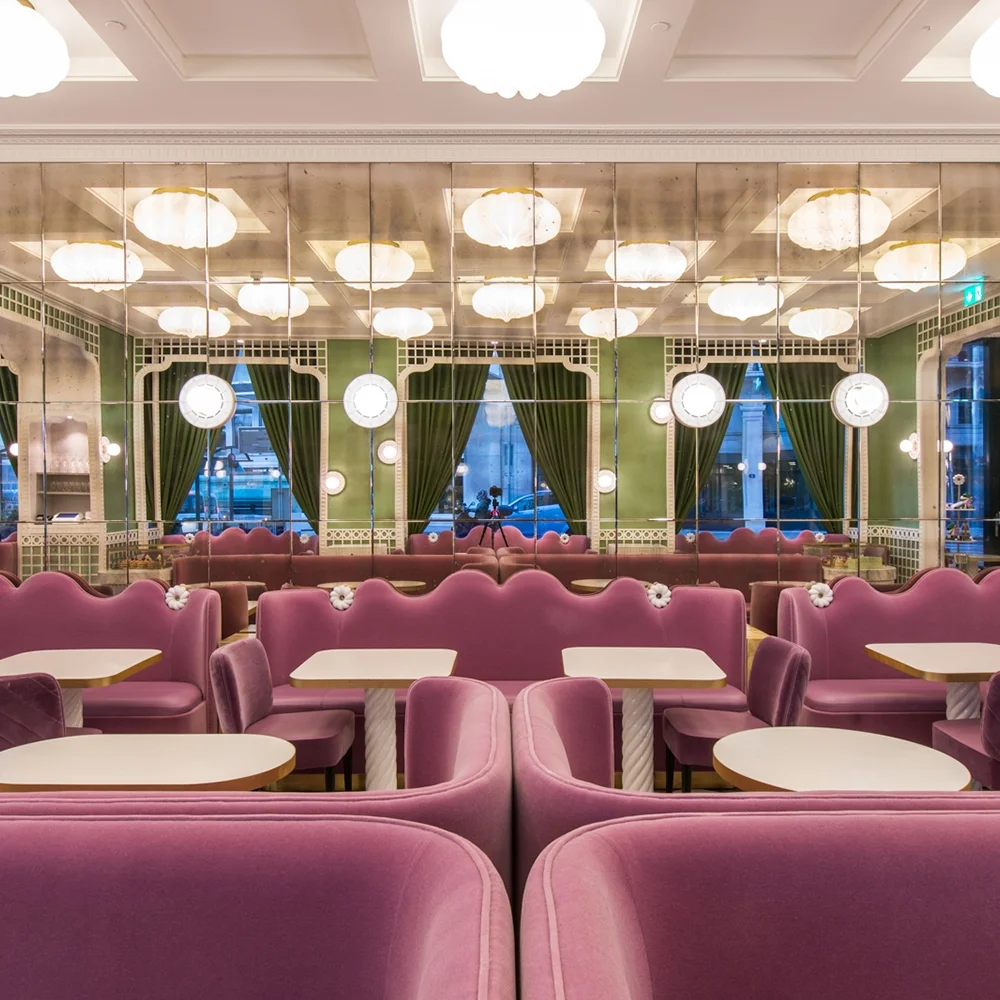
June 17th, 2013 – Sydney-based architecture and interior design practice Blainey North and Associates’ have re-invented one of Melbourne’s prized restaurants, Conservatory. The new Conservatory makes guests feel like they have been instantly transported to London, Shanghai or New York during an era when craftsmanship and materials were revered and buildings and interiors were designed to endure and built to last.
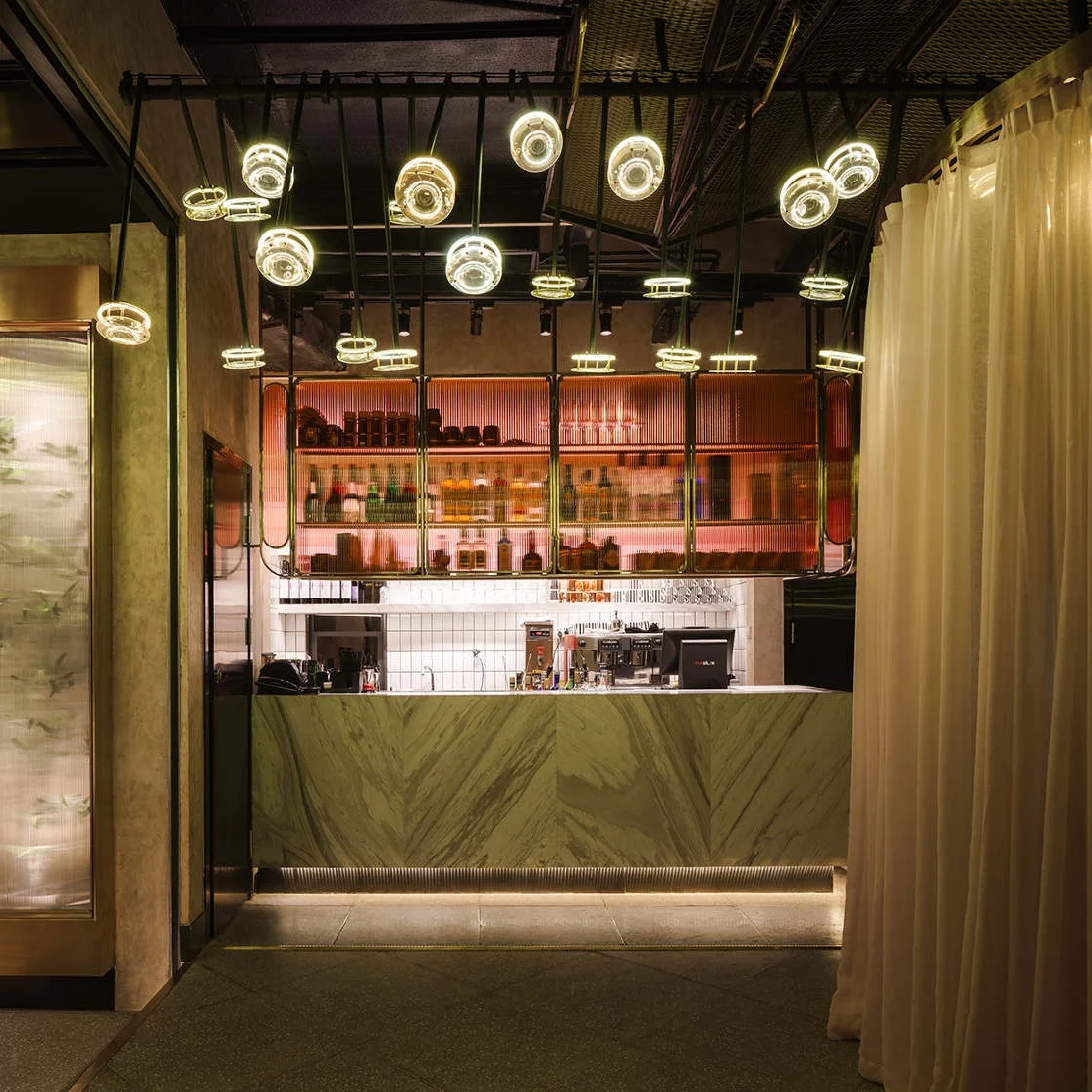
Located in Melbourne’s Crown Towers’, the new eatery draws inspiration from the grand conservatories of Europe. “The adoption of century-old techniques set in a modern context, such as the use of traditional fluted details on the bar and the restaurant’s solid metal screens, along with the repetitive use of a soft arch formation, create a true mix of French-deco industria and old world decadence,” founding architect Blainey North says.
The restaurant is flanked at either end with floor-to-ceiling mirrors, which, teamed with double-height windows overlooking the Yarra River, create a natural light-filled and spacious environment.
North introduced a collection of white arches and columns outfitted with marble, paired with large Fiddle Leaf Fig Trees that are planted into the custom cabinetry. Together, the elements create grand proportions, and are the fine recipe to a splendidly regal experience for restaurant guests.
There are four distinct areas in which to dine at the 190-seat buffet-style Conservatory, including a small collection of tables assembled close to the antipasto, seafood, salad and cheese selections, an intimate area near the bar and two larger dining areas.
White marble floors, bespoke chandeliers, a woven timber ceiling, custom-made carpets, generous chairs and tables, locally made steel screens and dramatic reflective surfaces combine to create a lavish and engaging space in which to dine.
Designing the Conservatory led North and her team to experiment with distilling the concept of a space to a simple line drawing, then translating this graphic form into a repetitive architectural detail. The arch motif features on every thing from the chandeliers to the chairs, tables and wall detailing are intentionally intersecting.
Photography by George Apostolidis
MostraBlack 2013
Brazilian Designer Guilherme Torres Creates Cool, Sustainable, & Cozy at MonstraBlack 2013
June 13th, 2013 – In the 18th century, the word ‘hotel’ was defined, at first, as the official address of the King of France. The term was later extended to describe the aristocrats’ houses and became a synonym for a large private residence which stood out in the neighboring area. A common practice among elite members was to rent its pied-a-terre when they were away for long periods. That experience allowed tenants to enjoy, though for a short time, the exclusive and reserved luxury of the finest addresses in Europe.
From this concept, described by Jaques-François Blondel in several of his treatises of architecture, Brazilian designer Guilherme Torres took advantages of the sensations caused by the characteristics of the space allocated to him at this years MostraBlack.
MostraBlack is a 40-day annual event that brings creative and conceptual content of the top professionals in architecture, décor, and design throughout several areas of Brazil. Guilherme Torres and his team were selected by MonstraBlack to showcase an oasis of comfort and style right in the heart of urban chaos, baptized Hotel Black.
Cool, sustainable, and absolutely snug and cozy. The bamboo – with none of its eastern folklore – plays a central role in the project. Bamboo is used on the floor, ceiling and some of the walls, which divide the scene, with an incredible three-dimensional ceramic coating, almost optical – The architect’s interpretation of the legendary fresco paintings and tromp l’oeils of the court in the old continent.
The lighting technique, which illuminates the space with energy efficiency, is brought to life through large tensioned screen panels. The high standard interior architecture travels beyond modern and functional furniture – most of them designed by the architect’s team, specifically for this dreamy hotel. where contemporary masterpieces interact with the passer-by. It’s an invitation to relaxation. It’s unforgettable, to say the least, revealing the city at your feet.
During the forty days of shows, the last five floors of MonstraBlack’s Tower A, located in the complex WTorre Plaza, receive thirty spaces freely acclimated by a mix of new talent with renowned architects, decorators and landscapers coming from various states Brazil.
Brazilian designer Guilherme Torres and his design team at MonstraBlack 2013.
Photography By Guilherme Torres Studio
A Victorian Restoration: South Yarra House
June 12th, 2013 – Ever wonder what it would look like to paint your bedroom door neon green? Dash your walls with black polka-dots? Or hang a huge yellow chandelier over your dining room table? Architects Nick Travers and Justin Northrop, founders of Melbourne-based architecture practice Techne, weren’t shy to add playful splashes of color and quirky design details to their latest residential restoration, South Yarra House.
To celebrate the existing Victorian structure, the architects skillfully preserved the exquisite detailed lacework balcony, interior crown moldings, and arched hallways, then juxtaposed the space with modern design elements. Techne’s design concept for this residential alteration and addition was to pare back the fussiness of the existing Victorian residence and at the same time celebrate its stately proportions.
The family that resides in the South Yarra House are avid art collectors. Because of this, Travers and Northrop conjured up a monochromatic color scheme to showcase the family’s art and furniture which imbues the interior with a frenetic vibrancy.
After passing the zestful stained glass that surrounds the entry door, Techne composed an interior strategy, where each area of the home complements the next.
The living room and dining room are bursting with colorful attributes such as the visually engaging paintings by artist Abbey McCulloch resting on the mantle, bright orange decorative vases, and a contrasting zebra rug over the hardwood floors.
Upstairs, the white washed wood flooring is a stark contrast from the dark wood planks that make up the flooring on the first level. Here, Techne’s clients are able to showcase their art collection in a gallery-like setting; hanging masterpieces by the likes of Australian painter Darren Wardle.
A neon green door creates an imaginative entrance to the children’s room, where polka dot walls, bright yellow bed frames, and a unique red table set collectively tell a jolly story.
Employees Only: A Lunch Break at Berlin’s Tour Total
Leyk and Wollenberg created an L-shaped layout by securing a collective of wooden dowels from the floor to ceiling. The repetitive dowels create an interesting design feature while defining the spacial perimeters of the space. Central to the restaurant is a large food prepping and buffet station where Total’s employees gather around to load up on daily specials. Both, the dining area and the food counter are crafted from oak wood then stained in black to stand out amongst the neutral-toned color palette of tans and white. Various sized table tops and counters are methodically scattered throughout the lounge to promote a social environment for Total’s employees.
Photography by Die Photo Designer
In The Mood For Cheongsam
June 6th, 2013 – In it’s current state, modern Shanghai is booming with architecture, fashion, finance, and technology. As the largest populated city in the world, travelers flock to the metropolis to experience a city filled with lights, adventure, and a unique interpretation of western pop culture. Although there is much to celebrate about the city’s modern movement, it is undeniable that Shanghai in the 1920s and 30s, dubbed by the Chinese as the “Old Shanghai,” epitomized the most glamorous and most stylish of China in the last century.
The National Museum of Singapore recently exhibited the glamor of “Old Shanghai” in a exhibit titled ‘In The Mood For Cheongsam‘. Alluding to the title of the show, the design plays up the mysteries and subtleties of the Cheongsam, the traditional body-hugging one-piece Chinese dress for women. Evoked by the sensual quality of the Cheongsam, the exhibition, which was designed by Singapore based design studio FARM, takes the form of curvaceous walls like a large dress, sculpting pockets of spaces where each display conceals and reveals, teases and surprises.
The exhibition is one singular continuous space with curvaceous walls that entices visitors to move through the space. The creatives at FARM designed soft pockets of spaces throughout the exhibition, Sometimes convex, other times concave in nature; sometimes expansive, at times intimate. The exhibition is a spatial experience that continues to surprise at various sections within the singular idea.
Providing a context to the various sections is key to provide differentiation and a narrative to the exhibition. Circular plinths, employed throughout, alter in form to suggest these changes in narrative and context. Objects or simple furniture relevant to the era or theme of the section are also integrated together with the Cheongsam on display to create a mise-en-scene within the section.
The design of the Cheongsam still is influential in today’s fashions, as it has become the inspiration for recent collections such as Jason Wu’s Fall/Winter 2012 collection, Gucci’s Fall/Winter 2012 collection, and Emilio Pucci’s Spring/Summer 2013 collection, making the title of the exhibition ‘In The Mood For Cheongsam’ extremely relevant.
Work In The Park, Play In The Office
June 4th, 2013 – The new Dunmai office has taken over an old motorcycle factory in the creative plaza on Shanghai’s South of the Bund, a place that serves as a remembrance to the familiar stories about old Shanghai. Designer Thomas Dariel, founder of Dariel Studios, gutted the old factory and replaced the space with a pleasurable, relaxing and modern workplace that reflects the company’s dynamism and creativity as well as serving their professional needs.
It took an internal architectural reconstruction to memorialize this old 4-floor factory building, Dariel kept the building’s historical façade, but completely transformed the internal structure into an open, high 3-floor volume arrangement under the design concept of “work in the park – play in the office.” A concept that is reflected in the overall structure and in every detail of this edgy and humorous-looking space.
The internal reconstruction is a response to the friendly atmosphere to the open space required by the client. A 3-floor high central patio, furnished with large white lacquer desks, was built so that colleagues can easily communicate with each other despite what floor level they are on.
Dariel appointed shades of white as the dominant wall color to push out the dark and dingy feeling of the old factory, and to reveal the original structure of the building. The shape of the new internal structure is inspired by the branches of a tree. Drawers on the wall let people imagine that all the plants growing in that space are spreading along the wall and up to the ceiling.
In order to make people feel as if they were surrounded by nature in the given space, the designer attempted to move all the elements of a garden to inside the office: grass lawns under chairs and tables, gardener’s tools designed on the walls, swings displayed during afternoon breaks that exhibit the sweet memory of childhood, and a groove for flowerpots on tables.
The natural light has been designed to infiltrate the whole space, so that one could feel a sense of being outside. The color scheme consists of pure white but bold colors such as vivid pink or green are used ubiquitously for contrast and for developing natural energy.
The restrooms’ entrances are designed to look like open elevator doors. Thus, when one is in search for an elevator, he or she will be surprised to find that it is actually a bathroom. Even the toilet walls are creatively designed, for the designer pays homage to a famous French artist street style by using images from video games to decorate tiled mosaics. The design illustrates that working in an office can be a joyful and unique experience. An office space can be open and transparent, just like the glass walls and doors of many individual spaces in Dunmai Office.
Photography Provided By Dariel Studio
Holy Cupcake Lover’s Paradise
The collaboration between JCA and Les Bébés happened when Chiu and his partner were having a drink outside their office after a long night of diligent work. “Our friend who we have known from our dragon boat team rode their bicycle passed us.” Chui says, “we said hi and realized they were looking for a retail space around the neighborhood. We advise them about a shop that just came on the market by the corner of our office. The next day the shop was rented, and we were commissioned to design their first brand shop.”
“From the first meeting with the client, I was fascinated with the cupcake packaging, how a flat surface cardboard could eventually fold up to create a space that allows for the cupcake to be taken away.” Chiu explained. “After much study, this exact “folding” action became our main concept in creating a space where cupcakes and how we view/walk/rest/taste became a unified experience.”
The shape of the store is simple; rectangular with an a-frame ceiling, playing on the idea of the outside folding into the inside, and vice versa. Breaking the boundaries of interior and exterior, the clean glass facade is acutely cut into the perimeter of the space to abolish the division of exterior and interior. Secured into the glass facade is a black wooden door and a two-toned square shelf to display the daily cupcake special.
Inside, a long marble top counter stretches back to a black painted wall. On the adjacent wall, a long shelf functions as a bar top for the sweet-lovers to enjoy their treat. As the shelf stretches along the wall, it breaks up into tiny shelves to display the cupcake packages in a modern singular manner.
Chiu explained that the success of the first shop has prompted Les Bébés owners to open up their second shop: Les Bebes Cafe and Bar, opening soon.
Photography by Kevin Wu
Volkshaus Basel, Switzerland
May 28th, 2013 – Architecture firm Herzog & de Meuron is best known for erecting high-styled super structures around the globe. But the team of 40-strong are focusing their talents in their own hometown of Basel in Switzerland, where the origins of a 14th Century castle were in desperate need of a 21st century make over. Architects Jacques Herzog and Pierre de Meuron, founding principals of Herzog & de Meuron, took on the small hometown project in effort to bring a historical local establishment back to life.
The new Volkshaus Basel has been turned over numerous times throughout the years. Debuting as the Castle of Bailiwick, later People’s House Basel, then a brewery and concert hall in 1874, and after that the building functioned as a central meeting place for political, social and cultural activities. In 1925, architect Henri Baur transformed the historic space back into a concert hall for the folks of Basel to enjoy.
Herzog & de Meuron restored and preserved the building back to it’s 1925 glory specifically putting their focus into the design of the bar and brasserie.
“Based on the original architecture of 1925, the Volkshaus will be preserved in all its diversity and complexity and will reflect the spirit of its own history,” says Herzog & de Meuron Senior Partner Ascan Mergenthaler. “Our intention aims to revitalize the diversity of this location which is so important to the life of Basel, while at the same time restoring its architectural identity.”
In the Brasserie, the architects re-exposed the ceiling beams by taking down a dilapidated old ceiling from the seventies. Benches divide the Brasserie in different spatial zones with the help of the tin covered bar and tables. Suspended LED luminaries hang from the ceiling with blown glass diffusers that embodies the spirited chandeliers of the buildings early days. The chairs in the Brasserie are a replica of the original People’s House chair.
Seventeenth century etchings have been transferred to the green-toned wallpaper used in the corridors of the restrooms thus establishing a link with Basel in the days of the former medieval manor.
materials like tin, leather and wood, which acquire a patina through years of use. Striking architectural elements of 1925 have been reiterated elsewhere in various scales and articulations. For instance, the oval window above the entry resonates in the window to the public passage that leads to the inner courtyard, in the swinging door between the bar and the brasserie, in an opening that reveals the historical staircase and in the mirrors of the restrooms. The sinks in the restrooms are recycled items found in Basel’s building components exchange.
Photography by Volkshaus Basel
Monde Condominium Sales Center, Toronto
April 21st 2013 – Nothing woos over prospective condominium buyers quite like a supremely zen-like sales center. Designers Elaine Cecconi and Anna Simone, founders of creative firm Cecconi Simone Inc., designed a park-like setting indoors for the sales center at Toronto’s new Monde Condominiums.
Monde Condos is a new condominium project from the global development giants at Great Gulf. The project is currently in construction on Lower Sherbourne St in Toronto, but Cecconi and Simone polished off the sales center first. The center makes use of evocative materiality that encompasses stone, concrete, wood and plantings.
The ground plane is redefined by a “stream” of crushed glass; the ceiling re-imagined with starry formations of LED pin lights. Benches and cantilevered ledges in privileged corners offer moments of rest and contemplation.
The nature infused interior design of the 4,000 square foot sales center was inspired by Monde’s local East Bayfront, as it contains emerging potential for a thriving waterfront community.
With the utmost respect for nature, Monde is a man-made homage to the timeless elegance of the outdoors. This earthy philosophy is what led leading architect Moshe Safdie to pursue LEED Gold certification for the building.
Photography by Ben Rahn / A-Frame Inc.
Annie Aime Shop, Toronto
May 16th 2013 – Parisian retailer Annie Aime has moved west, setting up shop on the bustling streets of Toronto. Local designer John Tong, principal of Toronto-based creative firm +tongtong, spearheaded the design of the shop, creating an eye-twisting space that is bold, flexible, and an open-concept environment that can easily be transformed into a space for scheduled art openings and other Annie Aime events.
Tong outfitted the 800 sq. ft. space with stark white walls and oak wood flooring, which became the canvas for graffiti artist Pascal Paquette to create an “organic, almost spontaneous” graffiti mural. “It’s quite active. It’s dynamic. It’s textural,” says Tong.
The geometric display units, constructed of welded steel, are weighted so that they securely lean against the wall and can be easily moved throughout the shop with no fasteners required. “They’re layered into a space that is very animated,” says principal John Tong. “Bold colors and architectural expression were needed to really capture Annie’s personality. I got this from the very first time we met when she described her passion for what she does and the fashion she searches out for her clients.”
Tong also developed a low-lying stepped brick display unit down the center of the shop, as well as a floor-to-ceiling brick and wood shelving unit at the rear. “It gives the space a grounding with out being precious,” says Tong. “It brings a tactility and materiality to the space, which is otherwise made up of drywall, paint and steel.”
Tong visualizes the juxtaposition of the geometric racks layered over the fluid, almost malleable, graffiti as a built environment which also reflects the vibrant spirit of the labels she carries. The artistic design of the shop parallels the feminine, floral pieces as well as bold, architectural offerings from collections of Veeshoo, frrry, Outclass, Helene Clément, Prêt pour partir, Saint-James and Saisei. “Creating a space where Annie felt she could express herself, play and offer the treasures from her explorations and journeys to her guests has been a joy.”
Photography By Ben Rahn of A-Frame
REBRAND: Yoshinoya 2.0
May 13th, 2013 – Designers Four Lau and Sam Sum, founders of Hong Kong based creative firm AS Design Service Limited, are branding and re-branding gurus. When the duo were asked to assist in a massive tweak of Yoshinoya‘s brand, the long-standing fast food restaurant classic, they found a way to modernize the aesthetics and make each space distinctively unique. The team at Yoshinoya believes that it is important to synchronize with the trend even though the brand has a long history; it has to be innovative and moving forward.
Yoshinoya Restaurant in Tsuen Wan, Hong Kong
The architects were contracted to conjure up Yoshinoya’s new design concept then implement the concepy differently into restaurant spaces in Hong Kong’s Tsuen Wan, Tuen Mun, and Mong kok neighborhoods. The client wanted the design concept to be centered around the idea of a “home”, creating a relaxing and enjoyable dining environment.
Yoshinoya Restaurant in Tsuen Wan, Hong Kong
The idea of a home also brings out a people-oriented attitude that the clients wanted visually interpreted into the interior design.
Yoshinoya Restaurant in Tsuen Wan, Hong Kong
“In this design project, we had the opportunity to inject a sense of young, interesting, exaggerated, avant-garde, and experimental elements,” the architects explained. “We want customers to understand at the first glance, being simple and direct would make more sense.” Lau and Sum used the clients concept of “Home” as the core design element to build a “Modern Home”, to inject a sense energy, to a corporate brand with a long history.
Yoshinoya Restaurant in Tuen Mun, Hong Kong
Lau and Sum created three different design schemes for each of the restaurants, while staying true to the core design values of the re-brand. Each space incorporates the design concept of a “modern home” in a clever and playful way. At the Tsuen Wan restaurant, the outlines of a simple home create a stunning light fixture.
Yoshinoya Restaurant in Tuen Mun, Hong Kong
Over at Tuen Mun and Mong Kok seating pods are inspired by the form of a home, the architects even used the shape in the pick-up window and wall decor.
Yoshinoya Restaurant in Tuen Mun, Hong Kong
Recently, Yoshinoya’s main competitors also re-branded their company, going as far as to change their colors. It was important for Yoshinoya to stay true to their colors, but the company remained open to adding more colors to the interior design. The client also considered the linkage between traditional Japanese cultures to a part of the design but not too traditional.
Yoshinoya Restaurant in Mong kok, Hong Kong
The shape of a “house” in its simplest form became a staple piece in the interiors and the new graphics. Yellow pillar structures, geometric triangle patterns, giant Japanese chopsticks, Japanese wooden plate menus and Japanese roof tiles became the feature of traditional homes and a variety of combination of diverse elements. “We also found that the shape of a “house” has a high malleability, it could be used to link different areas and make the space more stereoscopic.”
Yoshinoya Restaurant in Mong kok, Hong Kong
The design of geometric triangles on the wall creates a diversity of design styles, and was inspired by Japanese origami, along with traditional Japanese chopsticks and wooden plate menus to create experimental and playful design effects.
Yoshinoya Restaurant in Mong kok, Hong Kong
The architects want Yoshinoya’s patrons to understand that “’less is more,’ we thought that a good design has to be “People Oriented”, to gain a win-win situation between client and their customers, and to achieve both aesthetics and practical is the most difficult, but it is also the most interesting and satisfying.”
Yoshinoya Restaurant in Mong kok, Hong Kong
Zense Restaurant, Bangkok
May 9th 2013 – After the unrest of Bangkok’s 2010 Red Shirt Riot’s where protesters set ablaze to a large portion of Bangkok government buildings. The Central World Complex, the sixth largest shopping complex in the world and new home of ZENSE got caught in the crossfire and was totally unrecognizable. Although ZENSE was situated towards the top of the building, smoke and heat went upward and destroy all furniture and finishing of all interior space on the tower. ZENSE, then a newly-opened with a growing reputation as one of the hippest restaurants/bars in the city, situated on ZEN Tower top floor, was one of the casualties of this unrest.
The Lighthouses At Pacific Bondi Beach, Sydney
May 7th 2013 – For the past few decades the weathering Swiss-Grand Hotel on Bondi Beach’s famed four mile stretch has been quite an architectural eye sore. That is, until developer Eduard Litver of Capit.el Group reinvented the structure into high profile Pacific Bondi Beach, offering 95 premium-end apartments, including 19 stunning two-level ‘lighthouse’ penthouses, 69 boutique hotel apartments, as well as a fashion and dining precinct combining restaurants, cafes and wine bars.
Occupying almost an entire block, Pacific Bondi Beach has design brief focused on creating a lifestyle destination that complements its natural environment. Capit.ed Group called upon celebrated interior designers and architects such as Koichi Takada, Architect Andrew Andersons of PTW, and Jonathan Richards of SJB to create the dramatic transformation.
The designers have each created a distinctive scheme that interprets and responds to the natural and cultural context of Bondi Beach. Working with the overarching concept of ‘Natural Luxury’, Jonathan Richards plays with texture, color and pattern, utilizing materials inspired by the natural environment of Bondi: bronze bench tops, Moroccan tiles and tactile, pebble-like carpets. The ‘Easy Elegance’ of George Freedman’s designs offer “cool, relaxed spaces where the sea and the air take precedence”, with an emphasis on polished luxury and elegant sanctuary.
Koichi Takada’s interiors, developed around the theme of ‘Elements’, make use of a neutral color palette and natural materials like wood and stone to create warmth and timelessness. Takada says of his designs, “I strive to find the perfection of what nature can offer in Bondi Beach, such as the ambiance of light, the constantly changing color, the texture of the beachfront environment and somehow bring it back as inspiration into the interior space.”
At the pinnacle of the development, the ‘lighthouse’ penthouses feature undulating rooftops that replicate the waves of the ocean and semi-automated and gull-wing doors and skylights, which bring the northerly sun into the apartments. In some cases, the outdoor space is as expansive as the indoor space, with lawns, winter gardens, outdoor showers, alfresco dining, fireplaces and pizza ovens integrated seamlessly with the interior living zones.
As well as the natural perfection that so captivates Takada, Litver notes, “there’s a real artisan movement that has been emerging for quite some time at Bondi, which is also very, very special.”
Given the scope of the project, it is not surprising to hear that a team of world-class designers and architects have been convened to turn it into a reality. In the first release of apartments last September all but two of the 75 apartments sold within the first two hours!
Photography By Sharrin Rees
Laem Charoen Seafood, Bangkok
April 24th, 2013 – In Bangkok’s seaside province of Rayong, a family-style seafood eatery designed by the Architects at Onion is adding a cozy, yet modern, atmosphere to the local dining scene. Modest beaches dotted around the Rayong Province are tranquil paradises for sea lovers who wish for hideaway places near the capital, a fitting place for Laem Charoen Seafood. The designers at Onion devised a hexagon pattern screen that creates partitions, adds architectural interest, and controls the flow of the restaurant.
Warm colors were introduced into the modern space to provide a warm atmosphere that best represents the identity of Laem Charoen’s 30 year old brand. Mint green glass railings, diagonal wood slats, and dining chairs upholstered in an array of emerald colored tones sit underneath custom made ceramic lamps that are coated in a copper color. At the front of the restaurant, the wooden hexagonal screens are open, but at the rear of the restaurant, the screen holes are filled with mirrors that reflect the geometric screens and create visual interest.
Photography By Pruk Dejkhamhaeng
Nickie Children’s Clothing Shop, Lishui
April 14th, 2013 – A new button-clad children’s clothing shop called Nickie is adding a dash of imagination to the streets of Lishui, in China. Japanese architect Keiichiro Sako, Founder of Beijing based SAKO Architects, designed the 850 Square foot Alice in Wonderland inspired store. “In this shop we wanted to create a surprising space for the kids” Sako explained “therefore we took Alice’s adventures in wonderland as our reference and exaggerated the size of the elements in order to surprise the kids.”
To create the magical and fascinating atmosphere that Sako envisioned, the team chose to focus on buttons as the main design element. Buttons represent clothing, and to kids, learning how to button your own jacket is a sign of Independence from parents.
An assortment of different buttons, from large to small, were used in various ways throughout the creamy white space. A variety of decorative buttons are situated on the facade and house the store logo, while Sako switched out the handles for buttons on the glass entrance doors below. Inside, long wood dowels extend from the floor to the ceiling and pass through the holes of an over sized button table top – kids size. Large white bean-bag poofs provide seating for the kid shoppers around the table.
Other wood dowels add support to the matching button clothing displays. The architect was able to keep the playful space harmonious by introducing repetitive curves found in the arch of the door, the roundness of the buttons, and the frames of the wall display.
Photography By Sako Architects
SpaQ at The QT Gold Coast Hotel, Surfers Paradise
April 10th, 2013 – Australia’s QT Hotels are gaining a reputation for their laid back, vibrant beach side vibe that has been arranged by Nic Graham, creative director of g+a. Graham designed contributed his colorful brilliance to the whole hotel, but recently completed the last phase of the project – SpaQ. The spa is outfitted with light tones of wood, then complemented with unique lighting fixtures, one of a kind furniture pieces, and local spun accent pieces. Bright colors and patterns offset smooth timber finishes for a cluster of designs and ideas that is vivid but not overdone. Each of the treatment rooms are designed to suit different personalities, guests are able to choose which rooms they best relate too. The spa even has a wet zone featuring a unisex hammam and ice fountain.
Photographs Courtesy of QT Hotels
The Gale South Beach, Miami
March 9th, 2013 – A fallen South Beach landmark is now upright and back to life. On a sleeping lot at the southwest corner of 17th Street and Collins Avenue, Miami hospitality group Menin Hotels boldly reinvented a Tropical Art Deco treasure through the lens of modernist luxury. The Gale South Beach, which is originally The Regent hotel from 1941, was designed by the creatives over at ADD Inc. The new establishment juxtaposes terrazzo floors, exacting light fixture replicas, stucco accents, and existing porthole windows with plush, contemporary flourishes such as silk wall coverings, dark wood paneling, and hand-woven area rugs.
The 1940′s structure has been reconstructed to house the 87 room establishment. When Menin purchased the property, it had been left dormant for so many years, much of the original structures had to be demolished, but the renovation promised to preserve the vintage luxury of Tropical Art Deco, integrating elements of contemporary opulence with tones of an Italian-themed escape.
A stroll through the lobby reveals a first glimpse of the ‘40s replica, rich with deep wooden-hued floors and panels from imported oak. A balance of light pours from classic chandeliers and ‘40s sconces, along with natural sunlight outlined by white marble window frames. Art Deco-inspired loungers transport company back to the famous era, which continues to translate throughout.
To celebrate the Gale’s history, the hotel houses The Regent Cocktail Club, a wood stricken libations tribute with a permanent and approachable home for the cocktail culture in South Beach. Just steps beneath Gale Hotel’s first floor, is the Rec Room, a subterranean lounge is anything but ordinary, offering an upscale yet approachable environment, reminiscent of a friend’s 1970’s basement.
The white and blue suites are covered in Russet wood, silver silk curtains and and crisp linens. The Gale adorns five different room selections boasting a 40′s South Beach glamor aesthetic with a complement of contemporary tranquility. Designed to cater to every type of retreat, from overnight to extended vacation, guest rooms vary in size, while still maintaining mutual design themes and elements.
Bedroom walls are clad in a black photo frame collage depicting the splendor of the ‘40s. Cozy beds and modish furniture are the main focus of the lengthy room, laced with Italian accents, marble bathroom.
On top the old Regent is a lengthy infinity pool that peeks onto the shore line and Miami’s signature white stucco structures.
Photography Courtesy of Gale South Beach Hotel
Crumpler Store, Melbourne
April 1st, 2013 – When Crumpler’s Creative Director, Sam Davy set out to shape the bag company’s 12th Australian store, he was bound and determined to build an interactive space and unique consumer experience that reflects both the local environment and creative path of the brand’s original design ethos. Crumpler partnered up with local creative and award-winning architect Ryan Russell, of Russell & George, to cultivate this vision for their new retail space in Prahran, on the south side of Melbourne.
The design of the store is based on the abstraction of a pixel. A space that merges lighting and different media to create a fractured urban landscape of light and moving images. Russell and Davy worked closely to design a dynamic space that frames and illuminates the products.
A three dimensional grid of light was introduced to showcase Crumpler’s vibrant bags and provide an energetic backdrop for a landscape of moving images, piles of grey rock, and grey concrete.
Davy explained that the “raw, contemporary textures and use of light and film projection within the store not only showcases the products but the design has enabled a regeneration of this iconic site on the corner of Chapel Street and High Street.”
Beyond the lightsaber grid, monochromatic finishes, and grey rocks piled along the floors – Russell made sure that Crumpler’s colorfully crafted goods would rightfully remain the center of attention.
Photography By Dianna Snape
La Plage Casadelmar, Corsica
March 20th, 2013 – On the shores of Corsica’s Porto-Vecchio, La Plage Casadelmar, a 15-suite boutique hotel will soon be opening its doors. Beloved French architect Jean-François Bodin, also responsible for creating the Mathaf: Arab Museum of Modern Art in Doha and the Cité de l’Architecture et du Patrimoine in Paris, took an old stone structure then used natural materials and simple lines to add a contemporary blend to the coastal surroundings.
To Gian Luca Bertilaccio, General Manager of La Plage Casadelmar, “Good design is about bringing out the best in your materials.” The hotelier continued to explain that he feels blessed to be in Corsica “because what is at hand is marvelous. The light here is pure and crisp. The elements, the colors, the food, the warmth you get from the people, these are all our raw ingredients. Our passion is to make these raw ingredients inspire us to create a hotel that has a genuine goodness about it. That is what this project is really about.” Bertilaccio uplifting design philosophy is what paved the way for Bodin’s architectural concept.
Bertilaccio used the natural treasures of the island of Corsica as inspiration. Corsica is well-known as a chic, seaside holiday destination. Set directly on a private, white sand beach in the bay of Porto-Vecchio, the hotel has uninterrupted views of the surrounding bay. Within easy reach is the charming old town, teeming with glitzy boutiques, international dining, lively bars and quaint architecture, all topped off by a laid-back seaside vibe. Just south of Porto-Vecchio are two of Corsica’s most famous beaches, Palombaggia and Santa Guilia, and in the summer, the modern harbor is flooded with luxury yachts and ferries.
An establishment that is privileged enough to have ocean front property is destined to showcase it. Bertilaccio added a series of twisted triangular tents over teak wood terraces to enhance the contemporary aesthetic. An arrangement of comfy conversational furnishings constructed out of earthy materials allows for hotel guests to eat, drink, and enjoy the views.
Inside and out, old stone has been blended with volcanic rock, resin, glass and 300 year-old oak, while the color scheme draws from the Corsican shoreline, with moss and olive couches, bright turquoise cushions, sandy browns, white and cream. The rooms follow a similar color palette and are decorated with lush plants and plush furnishings.
Everything here is inspired by life on the beach, from the outdoor day beds to the natural woven fibers and pastel colors. To add artistic depth to the property, the design team introduced decorative pieces collected from world travels, and the casual, savoir-vivre lifestyle of Porto-Vecchio.