Architecture
Keeping It In The Family: The Courtyard House
January 23rd, 2013 – Now this is how you keep it in the family! Victoria-based interior designer Andrea Moore designed the new Courtyard House, her father Lindsay build it, and with so much creative blood pumping through their veins, Andrea commissioned her sister Lachlan to Photographed the house. To top it all off, Andrea’s parents now live in the home, which sits in Gippsland, a picturesque farmland east of Melbourne’s bustling city.

The initial plan was to demolish the existing house and build a more modern structure, but as the planning continued, Moore discovered that the old house was structurally stable and too much of a gem to tear apart.

Adding new architecture to old architecture is sometimes sort of gamble, but Moore took six years of methodical planning and building to achieve the contrasting look. The house is visually and functionally separated into two parts. The bedrooms, study, and den are sectioned into the existing house, while the living room, kitchen, and garage occupies the newly constructed pavilion.

The old house has a symmetrical Foursquare layout, with rooms arranged on each side of a central hallway. Moore preserved the interior architectural details of the old house, but she updated it’s look by adding simple, minimalistic furniture pieces – most of the pieces were built by her father Lindsay, who is the owner and builder. Sometimes, achieving simplicity is hard, but Mr. Moore together with Andrea, discovered a visual balance amongst old and new.

A custom concrete bath, stone floors, and wooden accent pieces cultivate a soothing and earthy aesthetic in the Zen-like bathroom.

The common spaces of the new pavilion are lofty and flooded with natural light. In the living room, instead of accommodating a flat screen TV in front of the sofa, Moore opted for a large sitting window for her parents to admire the stunning landscape.

(Photography: Lachlan Moore)
Like A Ship Floating In The Desert
January 18th, 2013 – Any resort that lists their recreational activities as desert surfing, Camel riding, and sand skiing, is sure to perk some interest! The Desert Lotus Resort is located in the mystical Xiang Sha Wan, the “Sand Bay” of the Gobi Desert, in Inner Mongolia. Beijing-based PLaT Architects designed the concrete-less resort to work like a ship floating in deserted. The creatives at PLaT had to invent a new structural system that is fixed in the sands by panels and a prefabricated steel support skeleton. Free of tiles and bricks for construction, the resort is built with low carbon environment friendly materials to utilize solar, water and wind energy in the desert, reducing environmental pollution and strengthening ecology protection.
The architects use traditional Chinese idea of “Zhen”, which is, in simple words, the art of repetition of the same elements. Square white tent tops, rotated 45 degrees are connected together in a circular formation. The rotation of the squares in the same angle generates triangles. In consideration of the structure, shading, and wind, the architects integrated the function, form and landscape, resulting in a form of a lotus flower. The hotel aims to be an example of sustainable tourism in the desert, through networks that generate electricity and water in their own self-sufficient system for the provision and operation of the building.

The winters in Inner Mongolia are long, cold, and dry with frequent blizzards. But the spring, summer, and autumn are polar opposites to the winter, they are short, hot and arid, a time known for dangerous sandstorms. The adventure junkies who make the long trip to the stylish low carbon resort come to enjoy the mystical orange sand dunes, and the warm Hantai River, a branch of the Yellow River more than 200 kilometers wide. Stand and look into the distance here to see a vision of the colored sand hills that meet the charming glow under the sun as the breeze blows over the dunes making music.


The Encanto Hotel, Mexico
January 15th, 2013 - In the Encanto Hotel, the potential for amazement is constant. Architect Miguel Angel Aragonés designed the hotel, which is settled on the cliff side of Acapulco, with complete concentration and relaxation in mind. Aragonés took every little detail into thought while he designed the stunning 44 suite hotel, specifically the spiritual details, physical details, and economic needs of the establishment.

This specific region of Mexico, at the Bay of Puerto Marqués, has a jungle that goes all the way to the shoreline, causing the hotel to light up in the midst of the natural greenery. The crisp white architecture feels like a freshly cleaned sheet blowing from the line as it dries in the sun. Aragonés says that the architecture of the Encanto is a sort of like a labyrinth, a method some use for meditation purposes, where all exits lead to the ocean.

The architect candidly explained that he intentionally designed very private spaces throughout the “labyrinth”, narrow at times, with corners where only two people will fit.

“Everything was playfully created to generate continual momentum from the sea” Aragonés explained “to compel those staying there to seek and find a way out.”

Encanto is home to three eateries including Flor de Mar 360°, the hotel’s signature restaurant, lead by Mexican Celebrity Chef Monica Patiño, who conceived a menu of local cuisine with intricate Asian flavors.

One wouldn’t expect that the The Encanto Hotel was actually built with few resources, economic materials, and local labor. Under these conditions, Aragonés took a less is more approach to the interior design, allowing much of the existing resources to funnel into the architecture. The approach complements the architects goal of having very little distractions in the design of the hotel, allowing guests to take in more of the natural surroundings.

Aragones Labyrinth consists of long exterior hallways covered in marble and teak wrap around the hotel and lead to ethereal vistas of the horizon.

A black bottom pool with infinity ledge on one side and teak deck on the other is outfitted in Balinese loungers, oversize sofas, and surrounded in palms.

In 20 suites, Aragones integrated nature into the architecture by creating very little visual and structural barriers between the interior of the room and the terrace. A nearly frame-less sliding glass door is all that separates the room from the terrace, where a maturing trees springs out from the concrete flooring.

The Cultural Center of European Space Technologies, Slovenia
January 9th 2012 – Would you ever guess that a tiny little Slovenia mountain village is the home to a ground breaking rocket engineer who pioneered theories on long-term human habitation of space? That’s right! Herman Potocnik Noordung, the first theoretician of space, was raised on the hillside of Vitanje, where 18th-century chapels pierce through the tree tops and 13th century frescoes are delicately preserved. It is Poto?nik’s theoretical work that brings the new Cultural Center of European Space Technologies (KSEVT) to the small town today.

It was only a few years back when leading architects Rok Oman and Spela Videcnik presented their proposal for the competition to win the bid, on behalf of their Ljubljana-based architecture firm OFIS. “The concept design for the building of the KSEVT derives from the habitation wheel of the first geostationary space station described in Noordung’s 1929 book,” the architects explained. “It will have a public significance and generate social, cultural, and scientific activities, with fixed and temporary exhibitions, conferences and club/study activities.”

Noordnung’s space station was designed as a geostationary satellite out of three parts: a solar power station, an observatory and a habitable wheel. After several decades of pondering on the habitation of space, this idea remains to be the most revolutionary, yet not realized. The rotating habitable wheel, a circular construction setting up artificial gravity with the centrifugal force, is the best and at the same time a simple solution for long-term human habitation of weightlessness. Since we are not accustomed to that kind of condition, it exerts negative influence upon our body in the long run. A station in this orbit could also represent a perfect point of departure for longer spaceflights, considering that the Earth’s force of attraction is still the greatest obstacle for that.

The building is a monolithic concrete structure, positioned freely between a main road on one side and a stream with a green hinterland on the other. The exterior and interior of the building are made of two low cylinders. The bottom one is larger and rises from the North to the South, while the upper cylinder is smaller and joins the larger one on the south while rising to the North. The bottom cylinder is supported by the transparent surface of the entrance glazing.

From the exterior, there is a dynamic effect between the cylinders, accentuated by the full glass rings around the building. The building appears to float and rotate on its southern and western sides towards the road. The entrenchment of the building into the surface on the other side gives a connection to its immediate surroundings. The spatial effects give the building the effect of artificial gravity from floatation and rotation. The building has two entrances- a main one to the central space from the square in front of the building on the south-eastern side and the northern entrance from the gravel surface above the stream.

The main entrance covers the overhanging part of the bottom cylinder: one passes through a tight space past a circular vestibule and into the interior of the hall. The vestibule can be separated from the activities in the hall by a curtain. The entrance glazing can be completely opened and can connect the activities in the hall with the square. The circular hall for 300 people is surrounded on both sides by a semicircular ramp. This denotes the beginning of the exhibition area, continuing from here to the overhanging part of the larger cylinder.

On the west, there are smaller office areas along the ramp. Ascending this ramp also represents a transition from the bright space of the hall to the dark exhibition area. The vertical connection with a staircase and large elevator connects the exhibition area directly to the vestibule of the hall. The exhibition space continues through the landing between the elevator and the staircase to the smaller cylinder, the multipurpose hall, and a raised auditorium above the hall. From here, one can observe the activity below. The smaller cylinder is concluded at the highest, northernmost portion with a club area devoted to researchers of the history of space technology, where they can focus on their work aside from the activities below.

Besides special program and location also collaboration of four architectural offices in developing the project is unique. The idea of collaboration raised on the first meeting where investor invited the four offices to collaborate on internal competition – and office principals decided to actually rather do the project together. The idea concepts came out on serious of workshops, later project was shared in different stages of development between all offices.

The 33 Mackenzie Tower, Melbourne
January 8th 2013 – Architects Callum Fraser and Zahava Elenber of Elenberg Fraser’s have unveiled their newest residential project, the 33 Mackenzie Tower, which has erected at the edge of Melbourne’s Central Business District. The stunning white tower creates a vertical village that follows a story of ascendance and transcendence, inspired by the ancient myths of the angel Metatron (or Enoch, or Elijah) and Pandora’s Box.
The stark white tower can be seen from afar as it easily competes to standout in the cityscape. “The buildings are clad in Metatron’s feathers,” the architects explained “at the lower levels, the loose feathers wrap around all four sides of the podium, forming a sunshade around the bronze glass. The upper levels of the tower are abutted with white concrete panels that also feature feather-like forms, giving them nap and grain. Balconies are recessed into the tower blocks so that the eye reads the full form.”

Beyond the striking exteriors, the architects outfitted the entry way and interiors with a contrasting pallet of colors and materials, this is when, as the architects concept goes, “you open Pandora’s box and ascendance shifts to transcendence.” In the lobby, infinite mirrors create the sensation of a body suspended in space, and a sophisticated lighting system adds to the experience.

A large perforated black wall at the entry way leads into the lobby, creating a contrasting effect as white light beams out from behind it.

This mail room is sure to have any post man dressing up for the occasion of delivering packages. Rows of blacked out lock boxes are secured to the walls, some boxes function as mail boxes while others are fixed to pull out and provide up-lighting.

A starry mirrored hallway leads residents through the milky way to the elevators which raise you through the tower – remaining consistent with the ethereal concept of the design.

The optical illusions of the design continue in the mail room with a tinted mirror ceiling that reflects the up lighting and creates a sparkly aesthetic!

The starry eyed design takes some time off once the twinkling view of the city becomes a major part of the ambiance up in the residential suites.

A warm and earthy color pallet completes the minimalistic design of the apartments as a full kitchen of Carrara Marble with contemporary furniture and accent pieces allow for a relaxing experience.

Conceptually, the architects dreamed of covering the tower in Metatron’s feathers. In actuality, the design concept manifested into white concrete panels that create a dynamic geometric pattern for the city of Melbourne to admire.

The Fingal Residence, Australia
January 3rd, 2012 – We recently did a full spread on Farmhouses Al Fresco, where KNSTRCT examined the way farmhouses are evolving with modern architecture. Today’s architects are pushing the boundaries on these countryside homes by transforming them from a simple hay-holding barn, to full blown residences. The most recent to catch our eye is The Fingal Residence by Australian-based JAM Architecture. The dark wood homes is located on the stunning Mornington Peninsula in Victoria, Australia, where rolling hills, meet rugged cliffs, all the way to the crashing waves on the shoreline.

The architecture of the home gives a humble nod to the design of old farmhouses with rich color wood slats, and open garage to pull up trucks and tractors, and a large sliding barn door. The architects took these throw-back elements and added a contemporary twist by introducing clean linear lines in the architecture and a minimalistic aesthetic.

Long reclaimed wood steps with flowers, hand-planted in metal baskets, lead the way to the homes entrance.

Above the steps, a white canopy ceiling trails from the outside garage all the way into the interiors making the design cohesive as visitors pass through the frameless, floor-to-ceiling, wood slatted door.

Furniture designer, Ocho’s Acapulco String Chair provides a place to relax while admiring the picturesque view of the rolling hills that lead to the bluffs in the background of the symmetrical pool.

Typical barn house interiors? Not so much, but not that far away! Stark white walls create a canvas for washed wood accent pieces, thick shelving, mid-century dining room chairs, and dark meal birdcages for lanterns.

A long skylight allows for natural light to pour into the kitchen, while the birdcages illuminate the dining room. The public areas of the home are open to one another as the private areas and bedrooms are tucked away to the second level of the house.

Each room is elevated to the second floor and has a magnificent view. The bedrooms continue the minimalistic concept of the home with sparse furniture, wood walls, and a low bed frame.

Because the Fingal Residence does not have very many neighbors, JAM decided to take advantage of the quiet property by allowing the master bathroom to fully open up to nature.

Tomorrow’s World: What To Expect From Architecture in 2013
January 2nd, 2013 – This marks our first article in 2013. We are heading into the new year with an overflowing amount of positive vibes for what’s ahead, so we’re examining 10 amazing projects coming to realization in our near future! That’s right, What does 2013 have in store for us? With great talents such as Zaha Hadid and Henning Larsen We’re seeing curves like we’ve never seen them before. The Danish architects over at BIG are taking their name to a whole new level as they recently unveiled their extraordinary Phoenix Observation Tower, which will have people flocking in from all around the world to experience. A hotel built into a mountain deep into the desert, why not? Florida-based Oppenheim architects will be working to build out their Wadi Rum Desert Resort which is designed to devise a new contract between man and nature. The idea of connecting man and nature through architecture has been a long standing concept through history, but in 2013 we will be seeing this idea manifest in a whole new way – in the sky, desert, jungle, and water!

Oppenheim architects have designed a series of beautiful tree top villas with the intention of integrating nature as as a major ingredient of the material palette. The team explained that “the architecture is reduced to the essential components for shelter—amplifying the ever-changing sky, water and vegetation that define the experience.” The elevated position of the structure allows for them to have little impact on the ground plane letting the undisturbed natural landscape to flow under them as an integral part of the design. These villas were originally designed for the Mandarin Oriental Group on a private island in Turks and Caicos, but as the concept has been widely admired, Oppenheim is in early works to build a similar piece elsewhere.

The Goldstone Winery in Dalian City of the northwestern portion of China, is an angular new build by the architects at OSO Studio Limited. This new take on a ‘wine house’ is a cool juxtaposition to the rolling hills of grapes and shrubbery. The architects said that they “developed a set of diagrams to define the building within the intersection of natural context and architectural typological.” First, the team proposed a semi buried volume to meet the physiognomy of the site; building’s two boundaries and contour lines coincide, another two boundaries’ angle are adjust carefully to make the building seems meet the entire site program arrangement “accidentally”, respect the nature context and declare its existence.

Oppenheim is bursting at the seams with a collection of jaw-dropping new projects, we couldn’t help but feature another one. The Wadi Rum Desert Resort in Wadi Rum, Jordan will be a 80,000 square foot hospitality experience for design lovers, adventure seekers, and people who want to re-connect with nature. Oppenheim’s mantra for the underlining concept of the project is “to live in harmony with the natural world, we must learn how to re-engage the land.” The idea led to the creation of a powerful and primitive resort which is built into the mountain side. This project is set to start construction soon – we’re hoping to see it built in 2013, but it will be well worth the wait if it emerges the following year.

AS. Architecture-Studio projected Cultural Center of Muscat, Sultanate of Oman, will bring together the country’s National Archives, the National Library and the Omani National Theatre all under one roof. The center is covered by a rolling canopy in a jungle-like setting between the sea and the mountains. The palm filled oasis is designed to be a connecting link between the past and present of Muscat.

The Mobius’ House by Planning Korea, is to be built as a two-story leisure house with a curved roof securely nestled into the Gotjawal Forest. The form of the structure appears to be a continuous ribbon wrapping around the home with a side of the house that has full glazing to provide amazing forest views. The Mobuis’ will be stand-out house in the near future, and will help continue the exploration of unique residential designs in the industry.

We’re looking forward to the completion of Saunders Torngasok Cultural Centre in 2013, as the curvy monolithic structure takes on a new-age form combined with local natural materials. The building’s windows are undefined, but exist only within the vertical wood slats which create the exterior walls. The center sits in between a lake and the mountains and will be used as a large exhibition area, auditorium, café, craft shop, and an artist studio.

This is nothing new for Denmark-based BIG Architects who went big with their new Observation Tower in Pheonix, Arizona. The founder of BIG, Bjarke Ingels, and his team have been responsible for some ground breaking pieced of architecture in the past 7 years, and Ingels is not about to stop now. 50 years from now, we will look back at Ingels as on of the most pivoting talents in architecture, and we are lucky to witness his work live! This year will mark the beginning of construction of the sky-giant known as the Phoenix Observation Tower. The 70,000 square foot deck is a slender reinforced concrete structure with a large spiraled sphere on top. Once visitors make their way to the top of the structure, they will be able to experience 360 degree views of the desert as they walk around the corkscrew deck. We’re not going to lie, we’re going to have to put on our big boy pants to go up the tower, because we’re getting a little scared just looking at the renderings!

Henning Larsen Architects The Massar Children’s Discovery Centre will be the heart of a Syrian educational program – Massar. The center will through science-based, hands-on experiences offer activities to empower young Syrians to contribute actively in building their future. The discovery centre has a unique location in the heart of Damascus. The building comprises exhibition, library, education and administration space. The centre will be an integrated main attraction within a new 170,000m² public realm on the site. The form is inspired by the unique Damask rose. The proposal suggests a shell structure allowing a playful and dazzling scenography of light into the interior spaces – like light filtering between rose petals. Exhibition and administrative areas are laid out between the rose petals creating interior labyrinth journeys inspired by walks in the old city of Damascus formed by walls with the sky as the window!

Another exciting project to come in 2013 is the Water Discus Hotels, which consists of two structural discs – one underwater and one above-water. This combination of the two will allow guests to admire the depths of the ocean while making the most of the warm climate. The two parts of the structure are connected by five solid legs and a vertical shaft containing a lift and stairway. One of the top discs will be a helicopter pad that will bring guests to and from the hotel. The creators of the project is D.O.T. (which stands for Deep Water Technology) started only two years ago with a specific goal to explore underwater living. The complex is surrounded by a beautifully vibrant coral reef. This unique location will allow you to enjoy the tropical weather and the colorful underwater world, which is just within your reach and will engage all your senses.

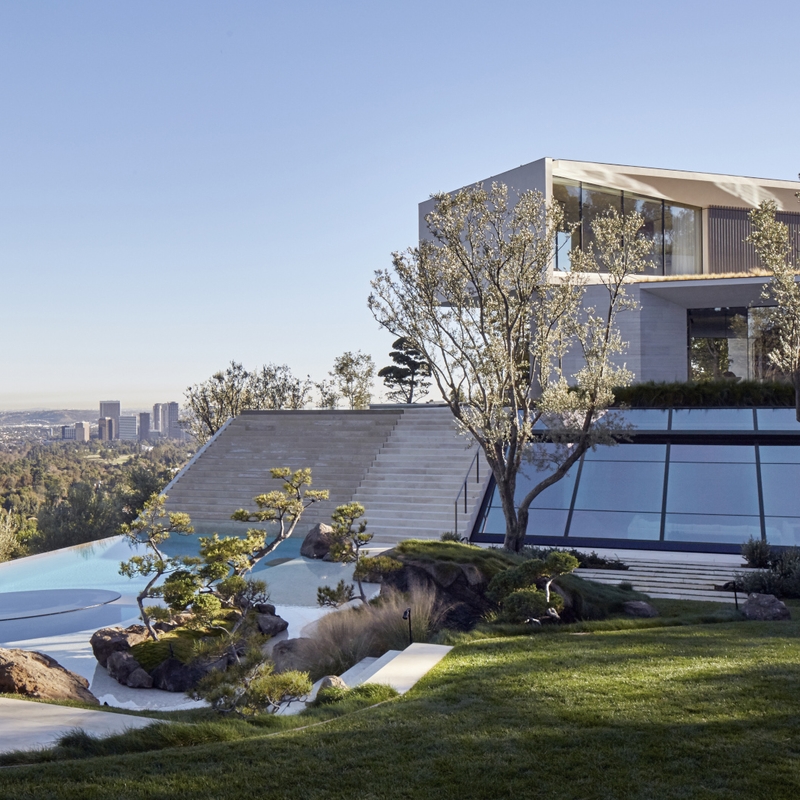
Los Angeles is known as the birthplace of American modernism with boxy homes flourishing through the 60′s and 70′s designed by the likes of Frank Lloyd Wright and Rudolph Schindler. This coming year, Oppenheim will be taking this idea of L.A. modernism to a whole new level. The Bel Air Villa is immersed in the hillside with clear views of both the Los Angeles and the Santa Monica mountain ranges. The house breathes some fresh air into the linear mid century feel by stacking two of the rectangular structures on top of one another, introducing a roof top garden, and a dramatic two-level swimming pool that flows like a waterfall!
Isbjerget Apartment Complex, Denmark
December 19th, 2012 – We are inches away from seeing the completion of the new Isbjerget Apartment Complex, located on the waterfront of Aarhus, in Denmark. Here are the first images of the nearly competed buildings by SeARCH Architects, who spearheaded the project in collaboration with JDS, Louis Paillard and CEBRA after winning a limited design competition a few years back. Isbjerget, which literally translates to Iceberg in Danish, is a suitable name for the sparkly white building with jolting peaks that sits directly on the water.

The waterfront development is happening because of a new initiative being funded by the local community to transform the old port into a cultural and educational center. Along with the new educational and cultural centers, there will be stores, entertainment, and residential units, such as the Isbjerget.

The master plan of the buildings consist of four L-shaped wings, the high and low angles of the structures elicit the project’s iconic strength while ensuring that all apartments take in an abundant amount of natural light and showcase the stunning waterfront views.

Isbjerget houses 155 one or two story apartments with commercial spaces that will operate on the ground floor. Some of the buildings reach 7 stories high, while others max out at 8. Each interior apartment forms to the dynamic angles of the exterior architecture, causing every unit to be different.

On the ground level of the building, along with the commercial spaces, are a number of 2 story townhouses that are integrated into the volume. Then, all the way at the top are the penthouse apartments, which are situated within the stunning peaks of the building.

Balconies feature glass changes in gradations of deep blue at the base to transparent at the top in keeping with the color of an iceberg. A cool mixture of apartments with different balconies, shapes and orientations ensure an urban living environment with social diversity.

(Photography: SeARCH Architects)
The New Festival Hall of The Tiroler Festspiele Erl, Austria
December 17th, 2012 – On a daily basis we are working hard at KNSTRCT to showcase architects and designers that express a new wave of energy into their work. We appreciate, and want to celebrate these creatives who continue to push boundaries and explore unpaved routes. Elk Delugan Meissl, Roman Delugan, and Sebastian Brunke of Vienna-based firm Delugan Meissl Associated Architects, are exactly the kind of folks we’re referring to. The team at Delugan Meiss have unveiled their latest project, The Festival Hall of The Tiroler Festspiele Erl, a dark angular structure that spawns outwards from a grassy knoll and reaches up towards the sky.

The new structure is built adjacent to the existing festival hall, a curved white building. “The festival hall’s geometry develops from the surrounding topography and places the building and the already existing festival hall in juxtaposition,” the architects explained.

The concept of the new build was derived from the idea that spaces of different zoning and configurations implement the focus on communication and peace, dynamics and concentration. The origami-like building is meant to complement the nearby organically shaped structure with a new sense of expression.

The sharp angles of the architecture continue onto it’s surface with a geometric pattern engraved into the building, which consumes the entire exterior. Architectural conditions in the building’s interior are devolved into a subtle control of the motion sequences through their sensual perception.

The access staircase is integrated into the terrain’s topography and leads visitors into the building’s interior. The foyer allows a wide range of impressions of the surrounding natural environment as well as to the existing summer festival hall.

Coherently, the approach to the concert hall is effectively emphasized by the gentle rise of the entry level. The concert hall, which is situated at the center of the building like a shell. This area is anchored to an existing large rock at the back, and is connected to the foyer via two accesses on each level.

The dynamic aesthetic of the structure flows into the concert hall with angular, acoustic bearing walls surrounding a plethora of seats. The walls are covered with dark wood panels with lighting discreetly secured underneath to light the 800 seat auditorium and 4,800 square foot stage.

Learn more about the Festical Hall, Delugan Meissl Associated Architects, and their work here.

(Photography: Brigida Gonzalez)
The MABIC Library, Italy
December 15th, 2012 – The Milan-based creatives at Andrea Maffei Architects, redefined an old warehouse into a captivating library in Maranello, a northern-Italian town best known for their historic Ferrari factory. The two story library is constructed in the form of a curvy, organic shape, but is protected by a boxy surrounding perimeter wall. Between the curvacious structure and the wall is a shallow body of water, which extends north to the entrance. To access the library, book lovers must walk on a concrete path around the water, to the point of entry.
The MABIC Library is filled with a collection of books, magazines, newspapers, a toy library, offices, multifunctional rooms, work stations, restrooms, and a consulting area. “The stoneware colored floor planks and the white furnishings combine to create a diaphanous and absolute space, in which books and encyclopedic volumes, also distributed along the curved wall, become the predominant elements ” Andrew Maffei, principal architect, explained. “The transparent wall provides great natural light in the reading room, supplemented in internal areas with skylights. The artificial light, produced by energy saving fluorescent lights, integrated by LED lamps on the tables, enables an increase by stages of artificial lighting in order to limit energy consumption.”
The surrounding pool on the site constitutes the element of interconnection between the perimeter squared existing walls and the curved surface of the library. On the bottom of the pool, as on the roof, there is a layer of white gravel, which reduces the “heat island effect”. The completely vegetated outer walls, acting together with the water, provide for the improvement of microclimatic conditions, air purification, noise mitigation, as well as psychological and social benefits – as the water allows readers to relax as they study.


(Photography: Alessandra Chemollo)
Simone Handbag Museum, Seoul
On the first floor, UAD designed a flagship store for Simone’s own bags to be sold along with a rent-free workshop space for promising young designers to work and enjoy the experience of handbag-making.
A multi-brand store is planted on the second floor, this store will feature products of contemporary brands introduced in Korea for the very first time – such as Rebecca Minkoff, Kiechel, Milly, 49 SQ Miles, Carlos Falchi and Oroton among others. The store is outfitted with brick walls and dark colors with a long glass bubble-like ceiling fixture down the center - dimly lit specifically to showcase the lit bags.
Past the building’s entrance shaped like a small stage and down the steps will be the Museum Café and the Museum Shop. On the second basement, will be a rent-free store for Korea’s up-and-coming new handbag designers, where they can show off their own unique colors and designs. Also on the same level, there will be a workshop where anyone can try making a handbag themselves. Big and small machinery and gadgets needed for making a handbag, ranging from sewing machines to logo pressers and leather skiving machines, will help the public experience being a craftsman.
On the third and fourth floors below ground, some 500 different kinds of leather materials developed by Simone from around the world, including France, Italy, Spain, Turkey, India and Brazil, will be displayed in various ways. This space will provide a chance for not only handbag designers, but also for apparel and shoe designers, interior designers and everybody else to be introduced to new types of leather materials.
At the heart of the BagStage Building will be Simone Handbag Museum, set to show the history of handbags from the third to the fifth floors. Some 350 handbags from the 16th through the 21st Century will be on display, collected through global auctioneers like Sotheby’s and others from private collectors around the world. On the third floor, the Contemporary Gallery will show the modern history of handbags of the 20th and 21st centuries.
The Historical Gallery on the fourth floor will introduce handbag archives from the 16th through 19th centuries. To celebrate the opening of the world’s first Simone Handbag Museum, a special collaborative exhibition will be held on the fifth floor in conjunction with Italy’s finest fashion houses. Titled “Italian Carousel”, the exhibition will be a great opportunity to see how Italian luxury brands like Fendi, Prada, Gucci, Emilio Pucci, Missoni, Versace, and Dolce & Gabbana carried colors that express the history and traditions of Italy into their images and products.
The building will serve as a stage for bags, displaying the backstage of Simone who has been working as a collaborative partner with European and American high-end bag brands for 25 years.
House in Tavira, Portugal
December 12th, 2012 – A new angular home in the south of Portugal has become a man made centerpiece between a family of 400 olive trees. The stark white structure, which appears to be a new build, is actually the remodeling and reconstruction of an existing home that has been covered with a geometric shell-like architectural canopy for temperature control against the beaming sun. Vitor Vilhena, founding architect of Vitor Vilhena Arquitectura, explains that the “architectural concept seeks to create two parcels with separate identities, including one volume with irregular geometry and other volume of regular geometry that communicate through a glass hallway. The surrounding outdoors relate to the terrain, landscape and vegetation.”
Located near the sea in Algrave, Vilhena decided to speak a contemporary language through the form of the home, with references to the vernacular of algarve architecture, then carry that language into the interiors. The interiors of the home are mostly white, with cool grey concrete ceilings. The interior rooms happily fit into the slanted ceilings, as bookshelves and cabinetry take unusual form to tie into the sculptural architecture!
Neighborhood XVII Residence, Israel
December 4th, 2012 – Israeli-based architects Zahavi have just completed a cool contemporary villa on the stunning coastline of Ashdod. The main structure of the 4 bedroom house is built as one large box and dressed with medal cladding, then Zahavi added a white shell like structure around to the box giving the dwelling a more interesting shape.
The all white interiors add an uplifting and breezy feel to the space as it sits directly on the windy coast. Massive glass doors allow the interiors to open up to a teak wood deck which harnesses a swimming pool that has circular windows under the water allowing swimmers to see inside the basement level of the home!
(Photography: Epstein )
The Naka Phuket, Thailand
December 3rd, 2012 – Hidden in an ancient valley on the western edge of Phuket, The Naka is Duangrit Bunnag’s most daring hotel to date. Not only because the Bangkok-based architect, Duangrit Bunnag, set out to redefine the idea of an indulgent island escape, but also because he single-mindedly followed a dream: one that would allow the hotel’s guests to float among the trees. The result is a discreet, tropical hideout, with 94 glass-built villas cantilevering out from the mountainside to give endless panoramas of the sparkling Andaman Sea.
With an outdoor pool attached to each of the secluded living spaces, guests have all the privacy they need to find their natural equilibrium. At the rooftop spa, which overlooks the forest and the ocean, cicadas provide the spellbinding soundtrack to soothing body scrubs and massages. Guests can also unwind in the hotel’s Olympic-sized infinity pool, or feel the powder-fine sand between their toes on the wave-lapped private beach. Fresh market produce is served at the hotel’s three restaurants, including The Nava, which sits along a natural watercourse that Bunnag integrated into his final design. Here, as with the rest of the hotel, there’s a sense of being cocooned in a secret valley. Design Hotels, the company who represents the Naka, walks us through the new property which will open it’s doors this spring.
Designing The Naka should have been easy. The 1,740-acre plot provided plenty of space, and the valley location – complete with a private beach on Phuket’s west coast – was already postcard pretty.
But Duangrit Bunnag, one of the best-known minimalist designers in Thailand, is a man who likes to challenge himself.
Instead of opting for traditional Thai bungalows or a blocky concrete high-rise, he created a forest of stone- and glass-built villas. Soaring away from the mountainside, these spacious and simplistic pods give guests 180-degree views of the sand-edged shoreline.
“I wanted to create something different, and nobody has ever dreamt of that in Thailand,” Bunnag said. “Actually nobody has done that in the whole world: a six-meter cantilever of the whole room.”
Rather than uprooting the valley’s trees to make way for his ambitious villas, Bunnag decided to use them as a guide. If his plans overlapped with a mature tree, he would either change the dimensions of the building, or move it to another part of the plot entirely.
The result is that the villas appear scattered across the valley, with well-established trees – many of them more than 50 years old – sprouting up from the gaps in between. In order to support the local population of cicadas and butterflies, indigenous plant species were also added during construction.
At the center of The Naka are four wooden pavilions. The pagoda-like lobby is built around a series of upright columns, making the most of natural ventilation, while the onsite wedding chapel, accented by glinting black marble, welcomes couples through its semi-transparent façade.
Both the sweet-smelling spa and The Meka (a rooftop café 40 meters above sea level) offer views as far as Patong. This notion of being close to town yet sheltered from its day-to-day bustle is key to Bunnag’s concept.
He wants guests to know that they are cocooned in a secret valley, with total privacy guaranteed until they choose to go out in search of excitement.
(Photography: Design Hotels)
Oostcampus, Belgium
November 27th 2012 - In 1991, Coca-Cola called this shed home to one of its celebrated soda making factories in Belgium. Today, the 20 year old factory has been re-invented into a luminous landscape of clouds by Carlos Orroyo Arquitectos. A few years back, the Civic Center in Oostkamp acquired the building and funded an architectural competition to turn the space into a public administrative center for a network of towns nearby. “We decided to reuse the spacious industrial shed; not just to recycle materials like the steel, but to reuse the space itself, it’s foundations, enclosure, services, access, and all the “invisible” parts; and to turn it into a series of abstract clouds; a sheltered public space within a controlled weather environment,” The architects explained.
This functional, sustainable, and creative approach to the project is what led to Carlos Orroyo Arquitecto’s winning of the competition, and the eventual realization of Oostcampus. The outside of the boxy blue warehouse is cleverly juxtaposed with large circular windows, which stem from the ground and circle upward to mimic the abstract white cloud design on the interiors ceilings.
To follow suite with the sustainable ideology behind the projects concept, a covered bicycle parking lot was created that resembles the likes of trees and promotes visitors and employees to ride their bikes.
The architects noted that they “decided to reuse the spacious industrial shed; not just to recycle materials like the steel, but to reuse the space itself, it’s foundations, enclosure, services, access, and all the “invisible” parts; and to turn it into a luminous landscape of clouds; a sheltered public space within a controlled weather environment.”
“It is not uncommon to underestimate the value of all these “invisible” parts of a building,” the team explained, “this is combined with a far-reaching transformation of the interior.”
Shell structures have been used for almost one hundred years now, making it very easy to build them as a very thin layer; in the case of Oostcampus, they will be in GRG, only a few millimeters thick in the highest points, weighing a mere 7 kg/m2.
Building the cloud shell within the weatherproof industrial shed simplifies the demands – inflatable form work simplifies the building process. It creates a fascinating landscape for very little energy.
The openings among the clouds are equipped with simple devices that transform all kinds of weather conditions into wonderful events. The strong winds of the outside are transformed into electricity that feeds a disc of LED’s, an artificial sun that will bring joy to, for instance, wedding days!
(Photography: Miguel de Guzmán)
The Surf Shack, New York
November 18, 2012 – Roger Ferris, founder of the New York based architecture firm Roger Ferris + Partners, has built what he says is a “refined interpretation of the suburban American Dream: modest scale home, swimming pool, and travel trailer,” brought to life in the Surf Shack house in Sagaponack, New York. Ferris put a modern spin on a charming cottage and a retro PanAmerica Airstream trailer with a white monolithic Corian clad swimming pool. The stark white pool gives a cool contrast to the throw-back trailer, which acts as a pool house for the owners of the home during the hot seasons.
(Photography: Roger Ferris + Partners)
Tepoztlan Lounge, Mexico
November 13th, 2012 – It’s always a treat to wake up to an inbox full of awesome new projects to review, yesterday was one of those days, and to our delight, we received a message from our friends over at Cadaval & Solà-Morales, who unveiled their stellar new poolside lounge in Tepoztlan, Mexico.
We learned a little about some of Mexico’s magical little towns when we jetted down to Tulum last spring, sacred spots preserved and protected by the local people. Tepoztlan is one of those spots. The town is known as a place of legends and strong cultural roots. Its pre-Hispanic ruins, a preserved historic center, and a lush natural setting, have made this exciting place a haven for artists and intellectuals fleeing temporarily or permanently in the maelstrom of the Mexican metropolis. Eduardo Cadaval & Clara Solà-Morales, founders of Cadaval & Solà-Morales, built the Tepoztlan Lounge as the first phase of a larger project that includes a series of bungalows of various sizes and designs. The Tepoztlan Lounge will be the main community space, a catalyst for activities in the nature.
The project is a negotiation between interior and exterior, building a habitable pore space, which becomes the central space of the project. The boundaries between the open and the contents disappear to produce a single spatial entity.
The important thing is not architectural object, even its limits, what is really important is the spatial experience, and to build materials are used not only inherent in the discipline of architecture (walls, slabs, columns, etc..) But also softer elements and changing those who are given equal or greater value to build spatial experience such as plants, trees, flowers, vegetation, all generating a diverse palette and seasonal, to build a mixed experience that varies over time and it changes throughout the year.
The design provides for three separate dwellings designed according to the three planned activities each is defined by its use, but also by a clear container of simple forms.
The first contains a bar with kitchen, and a bathroom area and changers; the second is a playground that can be used in turn as a reading area when temperatures drop at night, and finally a larger container that is the living room, a protected, warm and comfortable suitable for conversation.
It is the desire for continuity between these three autonomous spaces where the project is strengthened and makes sense, continuous space is consolidated in full contact with nature but protected from the weather, which expands each of the spaces defined by containers defining a unique space that intersects each of the parts to build a continuum.
It is through the definition of this central space, through the definition of its form, the adjacent courtyards take its true value. These are as essential to the project as the building itself, and allow the construction of a single total experience. In the same way that the enclosures provide continuity to the central area with regard to use and space adjacent open spaces and provide the diversity qualify giving idiosyncrasy open space. The design of the pool is part of this strategy, and responds to the will of one of the spaces characterize lateral necessarily respond to formalize the structure of the Lounge, incorporating in its possibility of multiple uses of water and your enjoyment.
The building is constructed as a base to highlight the views of the mountains. The intervention wants to be extremely respectful of the existing context and understand that the vegetation and wildlife photography are the real protagonists of the project, two impressive trees exist on the site are incorporated into the space as if they were parts of the same program. The Lounge is constructed in white concrete not only for being in the local context of low cost, low maintenance, and high demand for labor, but also and above all because it allows the building to expose its structural simplicity and neutrality against a overwhelming nature.
(Photography: Sandra Pereznieto)
Farmhouses Al Fresco
November 13th, 2012 – We drove by a series of old dilapidated barns, on an early fall trip through New England this year, which prompted some serious curiosity about the evolution of Farmhouses, their livelihood, and their relevance in the 21st century. Prior to the 1900s, The typically timber framed wooden structures functioned as a closed storage area, workplace for farmers, and sometimes indoor pins for livestock. Today, farmhouses have become somewhat of a luxury as a new demand for a rustic and authentic aesthetic has grown. The place that used to act solely as a place for storage has evolved into including full on residences, offices, pools, and parking garages – as architects are pushing boundaries on the style and function of today’s barns. We pulled together some of today’s best barns that are carving the way for a new era of farmhouses, al fresco!
House Bierings by Rocha Tombal Architecten
Rocha Tombal Architecten took some inspiration from the idea of “sculptural eyes” for the House Bierings. After experiencing the entrance area and passing the gigantic pivoted door, the visitor arrives at the “heart of the house”, the kitchen. Here he looks through the big glass wall straight into the garden, which suggests being outside again. Behind him, the stair cuts a wooden wall inviting to follow the route towards the first floor. Its angled form and extreme proportions (small and high) and the daylight entering from the ceiling, offer the feeling of walking in a medieval street. At the end of it he discovers the living room, a quiet, north-lighted attic space, from which a big opening exposes the surrounding green like in a framed painting.
Fincube by Studio Aisslinger
Fincube is Studio Aisslinger’s first prototype for a moveable farmhouse. The Berlin-based architectural practice a created natural and high-tech solution to a modular, sustainable & transportable low-energy house. The house can be transported into any type of farm and function as a dwelling spot and home. The prototype of this small and transportable house is located in Ritten, South Tyrol, Italy.
Goodman House by Preston Scott Cohen
Restored and re-erected Dutch barn frame is contained in this house like a guitar in its case. The gabled barn form appears to turn outside in due to a passageway traversing the entire width of the house. The breezeway converts into a winter garden by means of slide up screen doors and roll down glass doors. Thermally transformable, the breezeway/winter garden saves energy costs while allowing visual access from the interior living space to the upper reaches of the unheated fifth bay of the barn structure.
Sheepstable by 70F Architecture
The city of Almere has a sheep population of about 80 sheep. The sheep are mobilized to keep the powerful weed acanthus or bears-breech that grows in the “vroege vogel” – forest and “kromsloot” – park in Almere under control. To centralize and house this population, a sheep stable was needed. The stable is designed with an a-symmetrical homogeneous cross-section. The construction (pine) and cladding (Western Red Cedar) are made of wood. Only the curved girders are made of steel. This was done to emphasise the tube-like shape of the interior, which would have been less strong using twice as high wooden girders. The tube has three strategically placed daylight openings, of which one is close to the floor level, so people can look inside even when the building is closed.
Petting Farm by 70F Architecture
Most city parts of Almere, a city with almost 190.000 inhabitants, have a petting farm. In the ‘den Uyl’ park there used to be one, but it burned down in the early 80′s, leaving only its concrete foundation. Early 2005 70F Architects were commissioned by the municipality of Almere to design a new petting farm on the exact location and the remaining foundation where portions of the exterior wall roll up to become feeding areas.
Art Warehouse in Boeotia by A31 Architecture
This modern day barn has been transformed into a working artist studio. The new structure is located in the North-South axis, while the orthogonal plan view is divided into 3 zones: Firstly, the cantilever with the balcony in the South, where the entrance is situated, secondly, the artist’s workspace and finally the attic in the North which serves as a storage space. A straight staircase connects the two levels, while the cantilevered concrete steps can serve as exhibition stands for the artist’s work. The wall openings, which relate to the Sun’s trajectory, the interior lighting and the ventilation, stem from transverse horizontal sections in the building shell. The sliced concrete blocks that are removed now function as benches for people and pedestals for sculptures.
Villa Chabrey By GD Architects
Villa Chabrey is an impressive farm villa, located in Chabrey, Switzerland, designed by GD Architectes (GeninascaDelefortrie SA Architectes FAS SIA). Sculptured in wood and fitting in with the topography of the orchards, this house reminds the world of a hangar and of a barn. It also preserves the rural characteristics of the surroundings and the organization of the surface area around the positioning of the space it follows the distinctive typology of a farmhouse. The house is organized around a central space-kitchen, dining-distributing respectively private area – bedroom, dressing room, office, the board friends, living room and indoor pool. If, in contrast to the traditional cuisine (the fire), distribution space allows a perception of a whole house and offers immediate relation to the landscape, other parts have a more confidential, both in size and framed by their connection to the outside.
Summer House In Southern Burgenland by Judith Benzer Architektur
The Summer House in Southern Burgenland (Austria) describes a sharp-edged cubature which fits into its surroundings through its simplicity and homogeneous appearance. In being used as a summer house, and by virtue of the installation of a wine cellar with production surfaces at a later date, the building’s design is oriented by the cubature of the Kellerstöckel (wine house) typical of the Southern Burgenland region.
Genius Loci House by Bates Masi Architects
Formerly a horse ranch, the rolling green pasture of the site is located at one of the highest elevations in Montauk. The extensive program is terraced and embedded into the steep slope of the hill without compromising access to the exterior or natural light. Approaching from the south, the house appears to be two modest and separate one-story ranch houses. Circling around to the north, the house unfolds to reveal a more extensive project. In this case, the conventional Montauk building typology of the low-pitched gabled roof is modified by the geometries of the allowable building envelope and height restrictions of the site. The ridge is offset and the walls converge, directing one’s view west to the lake. The optical illusion caused by the parabolic roof is visible on the South side and entices a second look, as do numerous other details.
Villa T by Architrend Architecture
The context is agricultural, a plateau with sandstone walls to divide the various portions of property. Once marked by the productive outposts of the “masserie”, farms with cultivated fields and cattle, today the Ibleo territory has changed its look. Instead of scattered farmhouses, isolated and divided by farmlands, construction has gradually filled spaces, erasing the network of isolated architectural complexes gathered around courtyards, like ‘pacific forts’. Nevertheless, the site of this project has partially conserved that precious idea of ‘isolation’, and the whole design comes to grips with this context, constructing a direct relationship with the landscape, faced openly on two sides, while emerging from it thanks to an eloquent contemporary design.
Aloni by decaArchitecture for Oliaro
This agriculture villa by Athens firm decaArchitecture is one of a collection of 24 to be introduced to the Greek island of Antiparos by Athens developers Oliaros. Aloni is one of seven already completed as part of Antiaros Design Properties, a development split over four sites that includes designs from Harry Gugger Studio and Atelier Bow-Wow. This villa has a roof supported on two parallel stone walls with the surrounding terrain continuing over it. The villa is punctuated by four courtyards which provide shelter from the wind and admit natural light. A seasonal lifestyle has emerged in the Cycladic islands, driven by the growing need for relaxation and recreation, both of which are mainly satisfied by the beauty of the landscape.
Whangapoua Sled House by Crosson, Clarke, Carnachan Architects
On the shore of an idyllic white sandy beach on New Zealand’s Coromandel Peninsula is one spot for this elegant barn, but the structure is movable. The Owners of the Sled House can simply attached the farmhouse to a tractor and transport it. The site lies within the coastal erosion zone, where all building must be removable. This is taken literally and the hut is designed on two thick wooden sleds for movement back up the site or across the beach and onto a barge.
House in Caledon by Ian MacDonald Architect
“The site is a 90-acre parcel of rolling farmland, located in Caledon, forty-five minutes north-west of Toronto. The agricultural property, natural topography, experiential sequence and an existing barn and stone farmhouse provide a dramatic situation for this new residence for a family of four. Careful siting re-presents this landscape’s rural character and the innate qualities of exposure and containment. The new house is a non-building, thereby leaving the original farmhouse and barn intact and entirely separate from the house.
The Screen House at Lien Collective, Singapore
November 6th, 2012 – Ko Shiou Hee, founding prinicpal of Singapore-based architecture practice K2LD, was commissioned to build one of the six dwelling spots that make up the Lien Villa Collective. Hee’s contribution, titled The Screen House, came in the form of a boxy white structure with a partially enclosed pod-like terrace stemming out from it.
In the suburbs of Singapore, The Lien Family’s 1930′s mansion is surrounded by green hills and exotic vegetation. The family brought six of their favorite local architects on board to add five new houses and renovate their existing mansion. Thus, K2LD was selected and their Screen House became realized.
Stacked three levels high, each level incorporating the idea of a screen with partitions of thin vertical planks. The screens create a dramatic effect throughout the home as the natural light casts silhouettes of patterns across the architecture, the concept even rolls into an organic shaped terrace, with screen walls which opens up to the swimming pool.
The screens are instrumental in temperature control and to provide a sense privacy to the residents who are close in proximity to their neighbor, as one entire side of the home is predominantly glass!
To see the rest of the Lien Villa Collective home check out an exclusive book called ‘No Boundaries’ by Pesaro Publishing, which reveals an in-depth look into each home.
Below, is the neighboring home to the Screen House, The Zig-Zag House by Ministry Of Design.
(Photography: Patrick Bingham-Hall)
Fazenda Boa Vista Clubhouse, Brazil
October 24th, 2012 – We have been slowly reporting on the development of Porto Feliz’s stunning new Fazenda Boa Vista. The residential and hospitality complex is located on a massive spread of untouched land just 100km outside of São Paulo. Early in the summer KNSTRCT shared the Fasano Hotel, which is in the company of a new spa, kids club, equestrian center, sports center, petting zoo, two 18-hole golf courses, golf clubhouse, swimming pool, most of which are designed by the beloved Brazilian architect Isay Weinfeld.
Weinfeld’s team has unveiled the complex in pieces as it comes to realization, which leaves us very excited to get an early glimpse of the new Golf Clubhouse.
The Clubhouse features a lounge, bar, restaurant, and office, with several open decks to have a complete view of the green rolling hills. The lower level of the Clubhouse is a ‘heavy block’, built in concrete and nestled with the downward slope of the terrain.
Up top, the structure is mixed of metal and wood, enclosed by glass planes or masonry walls – the building is laid out as a sequence of interconnected rectangular spaces.
Visitors are greeted at the Golf Clubhouse with a white monolithic façade with one large square opening giving the players’ direct access from the course to locker, massage and restrooms.
The interiors of the clubhouse are in suite with the signature Weinfeld look, an aesthetic that marries two common concepts: nature and architecture. Wooden floors plank their way through the open white-walled space as scattered pieces of hand crafted furniture find a home in small conversational areas.
Black and white still photographs with visual golf reference cover the wall of the lounge where golf enthusiast can enjoy the views.
JHSF, the development team responsible for the creation of the Fasano Hotels and Fazenda Boa Vista, is a well respected Brazilian company. Known mainly for creating fine properties with a high standard of service and sustainability.
The group has implemented these sustainable idea into the Fazenda Boa Vista complex by adding a sewage treatment station, Solar heating in houses, Ecological farms for replanting and sapling creation, A water reuse mechanism for irrigation and utilization of rainwater reuse systems, as well as supporting local enterprises to provide services and products such as milk and organic vegetables.
(FG+SG fotografia de arquitectura | architectural photography)
Lujiazui Circular Pedestrian Bridge, China
October 22nd, 2012 – Pudong is Shanghai’s newest district on the eastern side of the Huangpu River, a Special Economic Zone chock full of gleaming skyscrapers rising out of what was mere farmland only 15 years ago! A new girder bridge, called the Lujiazui Pedestrian Bridge, was constructed last year which connects visitors from financial centers to shopping in a safe and beautiful way. The 5.5-meter-high walkway can fit 15 people walking side by side and has become a fantastic tourist destination since its completion, which provoked photographer Viktor Lakics to go get a better glimpse. Lakics came back from his trip with some amazing new aerial shots of the bridge As seen from above, standing at one of the observation decks in the Oriental Pearl Tower!
(Photography: Viktor Lakics )
UN Studio’s New Haus Am Weinberg, Germany
October 16th, 2012 – With over 70 built projects to date, Ben van Berkel and his talented team at UN Studio are not afraid to leave their mark on this world! Whether it’s a sculptural super structure, or a curvacious pavilion, each new project is captivating, purposeful, and mind spelling. UN’s latest build, the Haus Am Weinberg, has been in the works for the past four years, which is short in architecture years, but quite long for the fans who anticipate UN’s new work.
The new home hails all the way from Stuttgart, Germany with pastoral views of the stepped terraces of an ancient hillside vineyard on one side and cityscape vistas on the other.
The team at UN explained the intentions of the curves, and that each undulation “reacts and responds directly to the sloping landscape of the site, where the scales and inclinations of the slopes which sculpture the vineyard setting are reflected in the volumetric appearance of the house.”
The interiors enhance the form of the home by a single gesture, ‘the twist’. “This central element supports the main staircase as it guides and organizes the main flows through the house. The direction of each curve is determined by a set of diagonal movements.” As the program distribution follows the path of the sun, each evolution in the twist leads to moments in which views to the outside become an integral experience of the interior.
Notes From The Architect: A double-height, glazed corner – which houses the dining area – opens up to extensive views towards the North-West and frames the vineyard hill which forms the backdrop to the house. Views from the living room are extended by means of a fully glazed corner affording open vistas toward the nearby park lands to the South-West. Further views from the twist are encountered on the second level, where the master sleeping and wellness areas are located.
Notes From The Architect: The interior of the Haus am Weinberg is arranged into spaces of varying atmospheres and spatial qualities, with the four glazed and open corners allowing daylight to reach deep into the house. The materialization of the interior of the house further accentuates the overall atmosphere of light by means of natural oak flooring, natural stone and white clay stucco walls speckled with small fragments of reflective stone.
(Photography: Iwan Baan)
Green Village, Bali
October 11th, 2012 – “Even sustainable timber can’t begin to compare with bamboo as a conscientious building material. With very few resources or attention a bamboo shoot can become a structural column within three years, and that house could stand strong for a lifetime,” explained Elora Hardy, the former Donna Karan print designer turned current lead designer of Green Village.
Green Village will eventually consist of 15 homes, set within a river valley landscape along Bali’s sacred Ayung River, and located within walking distance of the world famous Green School – but at the moment, only three of the homes are fully completed. The village is strongly based off the concepts of sustainability and artisan craftsmanship, as it is constructed mainly of Bamboo materials, and uses sustainable concepts in their purest forms. Hardy explained that her team is “committed to changing people’s perspective on the infinite potential of bamboo,” Hardy explained.
“Our homes are designed and built without disturbing the natural integrity of the land, therefore each home is truly unique. Our homeowners enjoy a global environment within a culturally rich Balinese community with access to world-class amenities including home delivery of some of the best organic products available on the planet from Big Tree Farms, owned by a Green School family, as well as events including the Ubud Readers & Writers Festival and restaurants like Mozaic; one of Southeast Asia’s most notable culinary destinations.” Hardy says.
“Our view on being green comes out of being logical, doing no harm and being conscientious,” says Hardy. “By utilizing sustainable materials and artisan craftsmanship mixed with social responsibility, we have created a unique development concept.” She continues to add that “a percentage of every villa sold is contributed to Green School’s Balinese Student Scholarship Fund that has already provided 15% of our current student body with a tuition free education. ”
(Photographs: Green Village)