Widgets Magazine

Architecture

Disrupting Design: ‘Living’ greenhouses that are uprooting conventional spaces

This post is curated by KNSTRCT in partnership with Jaguar. Experience F-TYPE.

June 12th, 2013 – Ever wish you could add a little more greenery and light to your life? Nope, that dead, neglected orchid in the corner of your cubicle doesn’t count, nor the flickering fluorescent excuse for a light. We’re talking about stripping down the walls and welcoming the sun with open arms (and SPF 75). We’re talking about ‘living’ greenhouses – a growing design trend.

‘Living’ greenhouses are re-defining the function of the classic greenhouse by utilizing the traditional plant conservatory as homes, offices, and restaurants.  The architects behind these brilliantly simple structures have been transparent in their designs. Literally. They’re providing a fresh perspective by breaking down conventional walls and erecting translucent spaces that flood living and working zones with warmth and sunlight.

Besides looking super cool and making your sad, stucco-clad neighbors obscenely jealous, these ethereal structures serve as veritable hot beds for inspiration and fresh ideas. You could say they’re fertile grounds for growth – personal or otherwise. Opaque wall treatments add privacy and sun protection, and proper ventilation systems can control heating and cooling. Not to mention, plants offer positive psychological effects and indoor air purification, removing CO2, which is correlated with lower work performance. One thing’s for sure, when it comes to living greenhouses, the only thing that’ll be in a vegetative state are the Ficus plants. We give them two green thumbs up.

Living Greenhouses, Greenhouses transformed into offices, homes, and restaurants

 Casa Mediterráneo Headquarters By Manuel Ocaña Arquitecto

Casa Mediterráneo has teamed up with Manuel Ocaña Arquitecto to breathe new life into an old railway station in Benalúa, Alicante. The archaic exoskeleton of the former station remains, while new life springs forth under the Klein-blue translucent roof.

Living Greenhouses, Greenhouses transformed into offices, homes, and restaurants

Casa Mediterráneo Headquarters By Manuel Ocaña Arquitecto

Sunlight reverberates off an aluminum lattice, casting a sea of blue shadows onto a range of event spaces, built to host exhibitions, concerts, shows or parties – all supporting Casa Mediterráneo’s pillar of fostering public diplomacy. Photography captured by David Frutos.

Living Greenhouses, Greenhouses transformed into offices, homes, and restaurants

 House in Yamasaki By Tato Architects

To combat short hours of sunlight in the winter, Tato Architects erected the top floor of their residential project inside sheds that sit atop the roof. Designed for a small family in a residential neighborhood in Japan, the project utilized translucent polycarbonate walls to allow for maximum sunlight, a stable indoor climate and ample ventilation for the lower floor.

Living Greenhouses, Greenhouses transformed into offices, homes, and restaurants

  House in Yamasaki By Tato Architects

 Brilliantly simple in design, the sunroom collects heat in winter, and exhausts heat in summer via the breeze from five motor-operated windows.

Living Greenhouses, Greenhouses transformed into offices, homes, and restaurants

Dome Of Visions by Kristoffer Tejlgaard + Benny Jepsen

Sitting atop Copenhagen’s rectangular urban landscape like a bubble perfectly poised to pop, The Dome of Visions’ delicately erected skeleton and glass-like façade almost create gravity-defying floating effect. Designed by Danish architects Kristoffer Tejlgaard and Benny Jepsen, The Dome encourages vibrant life in a space clouded by construction cranes and freight containers. Upon entering, guests’ senses are greeted with the warmth of a summer afternoon, the wafting scent of rosemary and the spectacular sight of a 100-year old olive tree.

Living Greenhouses, Greenhouses transformed into offices, homes, and restaurants

 The House Cafe Kanyon By Autoban 212

An angular steel and glass framework comprise the beautifully transparent House Café located in the Kanyon Shopping Mall in Istanbul. The brainchild of Turkish design firm Autoban, the cafe is an adaptation of the mall’s original architecture, revamped with a walnut platform that adds warmth to the space and elevates it to a whole new playing field.

Living Greenhouses, Greenhouses transformed into offices, homes, and restaurants

 Plywood Dome v.2 By Kristoffer Tejlgaard + Benny Jepsen

Featuring a bold kaleidoscope of color, Kristoffer Tejlgaard and Benny Jepsen’s geodesic dome brought a fresh perspective to the Danish music festival, Roskilde Festival.


Living Greenhouses, Greenhouses transformed into offices, homes, and restaurants


Plywood Dome v.2 By Kristoffer Tejlgaard + Benny Jepsen


Founded on the structure of a carbon molecule, the dome allows for substantial strength and stability, while the construction optimizes resources, using minimal building materials and boasting reduced energy consumption for heating due to minimal surface area and the aerodynamic form.

Living Greenhouses, Greenhouses transformed into offices, homes, and restaurants

 Garden Shed by Ville Hara and Linda Bergroth

The epitome of waterfront property, the Garden Shed by architect Ville Hara and designer Linda Bergroth of Hel Yes! features a unique prefabricated garden shed on a remote Finnish island. Customizing their prototype with a wooden floor, solar panels, steps made from reclaimed brick, safety glass and automatic openers to control the temperature inside, the pre-made greenhouse can be bought in four different variations and is built upon modular parts that can be assembled by simply using an everyday screwdriver.

Living Greenhouses, Greenhouses transformed into offices, homes, and restaurants

House NA By Sou Fujimoto

Mirroring spindly scaffolding, House NA utilizes an open floor plan with minimal walls, ever-ascending levels, and a bright, airy aesthetic. Designed by Japanese architect Sou Fujimoto, the Tokyo house is divided into three main stories, then subdivided further into staggered platforms. The open interior is comprised of 21 individual floor plates situated at various heights, allowing residents to move freely and unobstructed from one sun-drenched space to another.


A New Codfish Aquarium at The Ílhavo Maritime Museum

June 3rd, 2013 -  The codfish – “bacalhau” – has always been deeply knitted into Portuguese cuisine. Legend has it that there are at least 1000 thousand ways to cook it, making this fish a local foodie favorite. Architects Nuno Mateus and José Mateus, co-founders of Portugual-based architecture firm ARX, designed the Ílhavo Maritime Museum in the city of Ílhavo back in 2002, the finalized project was even deserving of nominated for the Mies van der Rohe Award in 2003.

Ilhavo Maritime Museum Extension By Arx Architects

Now, the museum is one of the most visited museums in the region of Centro de Portugal, telling a story of high sea fishing in the Newfoundland and in Greenland, as well as in the “ria” of Aveiro. The Mateus brothers have recently revisited their celebrated museum to design a new codfish aquarium.

Ilhavo Maritime Museum Extension By Arx Architects

The codfish aquarium connects two other buildings and is a complex built ensemble. At the heart of the building museum visitors will find the fish and the sea. The visitor’s path is a spiraling ramp, a journey that begins in suspension over the tank, to turn into a diving mode of gradual discovery, an experience of immersion in the cod habitat. The informal auditorium, with extensive visibility into the aquarium, marks a pause in the visit for contemplation and information about the life of this species.

Ilhavo Maritime Museum Extension By Arx Architects

The architects use their expertise in creating contrast and movement throughout the space as architectural elements such as ramped hallways, stairs, and exhibition features visually fold into one another, allowing the visitors to learn about the history of codfish fishing in a fantastic way.

Ilhavo Maritime Museum Extension By Arx Architects

The aquarium features a Sea Room that presents an interesting collection of nautical instruments and miniatures of ancient boats. The new extension will be the first in the country, and the ideal place to observe this interesting species with a closer look. The Codfish Aquarium is a must-see spot of the city of Ílhavo, which intensely promotes the preservation of sea traditions.

Ilhavo Maritime Museum Extension By Arx Architects

Knstrct on FB

 Photography By Ferndando Guarra at FG + SG – Fotografia de Arquitectura

MDT House At Fazenda Boa Vista, São Paulo

May 16th 2013 - São Paulo’s Fazenda Boa Vista development is a massive 1,800 acre residential and hospitality complex rolling with perfectly trimmed hills, deep blue lakes, and untouched landscapes. The property features an array of amenities such a clubhouses, an equestrian center, golf course, tennis courts, five star hotel, and a spa. Also within the complex is a collective of newly built residences designed by Brazil’s architectural headliners, Isay Weinfeld, Arthur Casas, and Paulo Jacobsen and Bernardo Jacobsen of Jacobsen Arquitetura.

MDT House By Jacobsen Arquitetura

Jacobsen’s new MDT house is in the well designed company of Fazenda Boa Vista’s newly built residences. The home is sectioned into three rectangular volumes that are juxtaposed together to create three full patios, a gourmet kitchen, home theater, large entertaining areas, a kids room, library, and a swimming pool.

MDT House By Jacobsen Arquitetura

The outside of the MDT home is outfitted with a stone wall covered in vertical wood panels ranging in hues of brown, orange, and yellow. The stone and wood wall constitutes most of the exterior walls, except for the areas that overlook the pool and courtyard. Here, the bedroom suites fit straight into one of the rectangular volume, each bedroom has a glass wall so guests have a view of the swimming pool through the wood panels.

MDT House By Jacobsen Arquitetura

One feature not to be missed is the large wood covered patio that overlooks the pool. On the patio, modern furniture pieces create unique conversation areas, and the gourmet kitchen is only steps away to feed the need for serving and entertaining.

MDT House By Jacobsen Arquitetura

The architects took a topographical approach to develop to sculpt the land of the MDT House. Variations in floor and ceiling create different ceiling heights and different relationships with the garden,
sometimes enabling direct access to the gardens and pool.

Knstrct on FB

     Photography by Leonardo Finotti

JN House by Jacobsen Arquitetura

May 14th, 2013 – Nestled among the forested hills of the Serra dos Órgãos is Petrópolis, also known as The Imperial City of Brazil. Petrópolis is a popular summer holiday spot amongst the locals of Rio de Janeiro, a perfect place for the clients of Jacobsen Arquitetura to build a new holiday home to have a place to spend their weekends and holidays with family and friends. Because the couple planned on filling the house with frequent visitors, it was necessary for Paulo Jacobsen and Bernardo Jacobsen, founding architects of Jacobsen Arquitetura, create a program cautiously thought to create the perfect wellness and relaxation center.

JN House By Jacobsen Arquitetura

Perhaps the title of JN House is a bit too modest of a mantra. Many might refer to this build more of an estate than a “home”, as the property features a main house, spa, swimming pool, pond, dog’s room, tennis court, leisure pavilion, hydro massage room, gym, small warehouse,  garage, office, home theater – to name a few.

JN House By Jacobsen Arquitetura

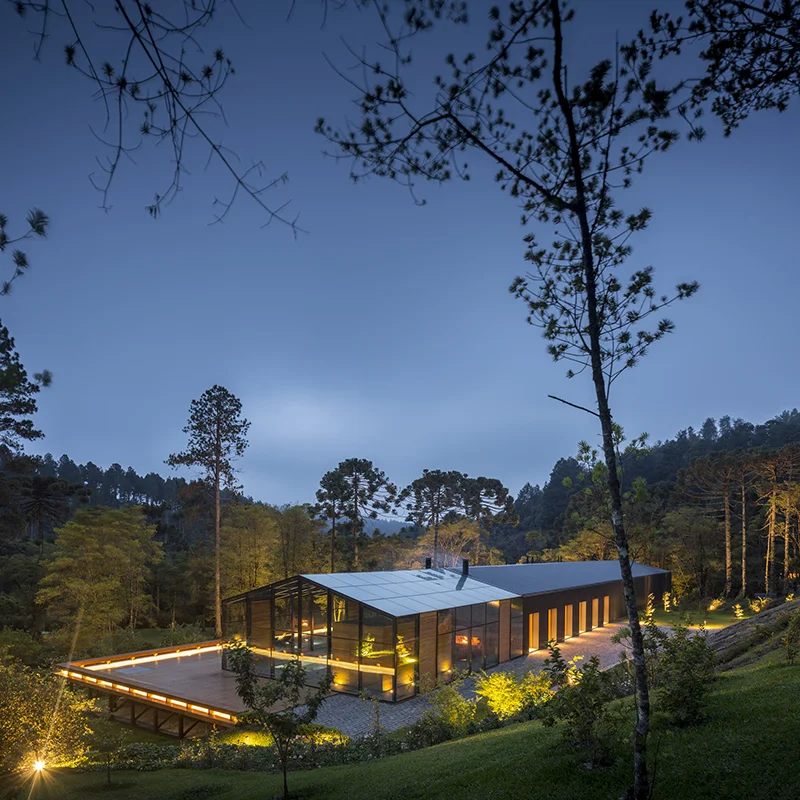
The architects took a topographical approach to develop to sculpt the land of what was to become the JN House. One concept behind the structure was to integrate architecture with nature, the elements that create the house were often hidden in the natural unevenness of the site, so there is mimicking with the land.

JN House By Jacobsen Arquitetura

Consequently, the construction was distributed through the land, being basically a single story house characterized by different independent blocks. Concrete structures and garden slabs bind into the topography and others subtly stand out through a mesh of wood in the landscape, created through a succession of structural frames.

JN-House-by-Jacobsen-Arquitetura-Brazilian-Architecture-1

The access to the house is through a paved pathway leading to a suspended volume. This creates a front porch with a stunning view of the rocky mountains in the background. From a central core of the main house, you will find implanted on the land the SPA located by the pool, the children’s house, leisure pavilion with a tennis court and further away from the house the maids’ quarters.

JN House By Jacobsen Arquitetura

The main house has a linear floor plan. On the ground floor of this construction are the living and dining rooms, lavatory, pantry, four guest suites and a deck. The deck faces the pool and spa. The guest suites have bladed louvered panels closing. In the inferior part of the house is the garage, office, lavatory, service area and a home theater.

JN House By Jacobsen Arquitetura

The garden slabs form a ceiling for some blocks of the house, so indoor comfort is maintained for visitors. The fireplace and interior gardens help regulate the temperature. The existence of large glass panels and skylights lets in natural light.

JN House By Jacobsen Arquitetura

The house generates different atmospheres depending on the brightness. By day the porticos create a game of exciting lights and shadow and at night the lights make the room cozy.

JN House By Jacobsen Arquitetura

Leonardo Finotti Architectural Photographer

Knstrct on FB

Villa Escarpa By Mário Martins Atelier

May 8th 2013 – Architect Mário Martins, founder of Mário Martins Atelier, has been molding the contemporary structures of western Algrave, Portugal for the past 20 years. Martins latest addition to the Algrave’s rolling landscape is the Villa Escarpa, a rectangular white structure suspended from the hillside that was inspired by the Bauhaus movement. The Bauhaus philosophy was founded on the principal that form should follow function, while all other distractions and decoration should be avoided. Martins relates to this philosophy and wanted the space to be understood for its purity.

Villa Escarpa By Mário Martins Atelier

The pairing of architect and client could not have been more perfect for the Villa Escarpa. In this case, the client and the Martins shared very similar definitions of “modern” and “statement living”, which gave the architect a clear direction for the design of the home.Martins believes that modern design can be achieved through several overriding principles – clean, straight lines, simple uncluttered spaces and a mix of natural and industrial materials.

Villa Escarpa By Mário Martins Atelier

The Villa Escarpa hangs from the hilltop, overlooking the crashing waves that smash against the cliffs that line the pretty village of Praia da Luz. The luxurious villa constitutes pure white lines, open floor plans and easy indoor-outdoor flow, combined with an abundance of glass for the owners to admire the oceanfront vistas.

Villa Escarpa By Mário Martins Atelier

The site of the villa has been landscaped with olive, fig, and almond trees, which were planted to preserve the natural surroundings of the National Ecological Reserve within which the property sits.

Villa Escarpa By Mário Martins Atelier

As an architectural showpiece, Martins cleverly designed the villa to maximize light and space. The stunning house offers five bedrooms, living areas, stylish kitchen with top appliances, private screening room, games area and a 4-car garage. The main spaces were constructed with glass walls that fully open up to the outside world.

Villa Escarpa By Mário Martins Atelier

The bottom level of the two-story rectangular home is severed down the center with a rectangular pool. Martins situated the pool in a high traffic location, a logical choice when it comes to the path of the sun, but also a place where the home owners would be hosting parties and entertaining guests.

Villa Escarpa By Mário Martins Atelier

Martins incorporated the small body of water into the layout of the home by including a series of steps that cross over the pool. Here, party guests would be able to grab a few bites in the open kitchen, then walk across the pool, and onto the terrace to admire the views.

Villa Escarpa By Mário Martins Atelier

Inside, Martins idea of “modern” is further expressed with a cool and neutral color palate that reflects the pristine atmosphere contrasted sometimes with edgy, unique and bold design accents. Unique and minimalistic furniture pieces are scattered throughout the villa with abstract canvased artwork as a backdrop.

Villa Escarpa By Mário Martins Atelier

Style, elegance and practicality are embedded into the design, combining crisp architecture, luxurious appointments and functionality that make the Villa Escarpa

Villa Escarpa By Mário Martins Atelier

Strikingly sleek, this ultra-modern villa redefines the expectations of Algarve real estate by being family-friendly yet über-stylish. Inspired by the streamlined Bauhaus aesthetics, the luxurious villa enjoys pure white lines, open floor plans and easy indoor-outdoor flow, combined with an abundance of glass.

Villa Escarpa By Mário Martins Atelier Villa Escarpa By Mário Martins Atelier

 Photography By Fernando Guerra

Knstrct on FB

One For The Library: Isay Weinfeld

April 6th, 2013 – Perhaps it’s not just Isay Weinfeld’s love for structures that renders him one of Brazil’s top architects. Weinfeld, a self proclaimed ‘sponge’, regularly extends his curiosity beyond design to the subjects of philosophy, astronomy, politics, music, cinema, and literature. The architect even organizes regular lectures for his office, discussing topics ranging from Existentialism to media. “Knowledge for him is a shared experience, not a solitary pursuit,” New York-based architectural designer and journalist Raul Barreneche explains as he treats archi-nerds everywhere to a wonderful written and visual exploration into Weinfeld and his prolific body of work in the new book, Isay Weinfeld.

Architect Isay Weinfled Book of buildings, homes, and hotels

Last week Weinfeld’s team sent us a copy of the book to experience the collective first hand. The book is an examination of seventeen pieces of work by Weinfeld, described with texts and pictures with more than two hundred beautiful photographs. Weinfled’s previous 2008 book was a guide through the architects residential builds. This new issue is dedicated to the architect’s commercial works, such as São Paulo’s upscale Disco nightclub, Galeria Luisa Strina, Clube Chocolate, Hotel Fasano, and Fadenza Boa Vista. For each project, Barreneche documents personal insights from Weinfeld, along with his architectural drawings.

Architect Isay Weinfeld Book of buildings, homes, and hotels

The book opens with a look into Disco, an upscale nightclub in São Paulo that Weinfeld worked on for six years. At Disco, Isay was able to “strike a balance between natural, and seductive black spaces that let music and dancing take center stage with carefully choreographed moments of color,” Barreneche explained. Upon entering the club, visitors are immediately submerged in a long tunnel outfitted in small rectangular mosaic tiles. It is here, that photographer Paulo Pampolin captured Weinfeld proudly standing amongst of his creation, as seen above.

Architect Isay Weinfled Book of buildings, homes, and hotels

Over 200 large photographs illustrate the volume taken by world renowned snappers like Leonardo Finotti and Nelson Kon, but this dreamy photograph of the Equestrian Center Clubhouse at the Fazenda Boa Vista was taken by Fernando Guerra of FG+SG Architectural Photography. The Equestrian Center Clubhouse evolved on the tail end of Weinfeld’s build up of the massive 1,800 acre residential and hospitality complex in Porto Feliz.

Architect Isay Weinfled Book of buildings, homes, and hotels

Another night club absorbing pages in the book is São Paulo’s Bar Numero. “Weinfeld is always orchestrating how visitors will move through the space,” Barreneche explains. “After crossing the steel walkway, one steps into a vestibule with walls and ceilings clad entirely in bronze mirror. From here, the entrance leads to a low-ceiling bar area – and then the drama unfolds as one gazes down the length of the 112,53 feet-long interior, which ends in a towering glass window. Beyond is an illuminated thick garden with palm trees, orchids, heliconia, and jasmine.”

Architect Isay Weinfeld Book of buildings, homes, and hotels

Barrenche also outlines the story behind the Fasano Las Piedras – Fasano Group’s first hotel outside of Brazil, in Punta Del Este, Uruguay. Barreneche noted that Weinfeld’s first visit to the vast, open land marked the integral preservation of the original hacienda of the property’s former owner. Weinfeld saw to it that the historic hacienda was organically woven into the design of the new hotel, where bungalows, pools, and pavilions are now scattered throughout the cactus-covered land.

Knstrct on FB

The White Chapel, Hong Kong

April 29th, 2013Defined by a rhythm of repeating layers, Architect Danny Cheng of Hong Kong based architecture firm Danny Cheng Interiors constructed an A-frame structure surrounded by a circular pond that sits on the coastline of Hong Kong’s Discovery Bay.
 

The White Chapel By Danny Cheng in Discovery Bay

The steeply-angled sides of The White Chapel pay homage to an architectural style that has been present through history. The A-frame structure is sharp, dramatic, and sculptural – and with the open rafters, Cheng was able to create a repetitive layering effect that hides all of the bulky technical equipment.

The White Chapel By Danny Cheng in Discovery Bay

The architect used white in the chapel to create a contrast from the stunning aquatic surroundings. A still, shallow pool of water surrounds the chapel, reflecting its image perfectly at night.

The White Chapel By Danny Cheng in Discovery Bay

Inside, the pews (chairs) are arranged in a traditional manner – cut down the middle facing front. On the stage, a long transparent Lucite table along with angular Lucite chairs leave the architecture uninterrupted.

The White Chapel By Danny Cheng in Discovery Bay

Cheng played with the idea of reflections throughout the space by introducing high gloss white floors that mirror the dynamic interior architecture. While outside, the pond creates a dramatic reflection of the exterior shape of the chapel.

The White Chapel By Danny Cheng in Discovery Bay

Knstrct on FB

Photography By Danny Cheng Interiors


PARKROYAL on Pickering, Singapore

April 25th, 2013 – We’ve been keeping a close eye on Singaore’s PARKROYAL on Pickering ever since WOHA Architects released their architectural renderings of a lush four-story hotel full of tall sky-gardens, reflecting pools, waterfalls, planter terraces and cascading vertical greenery, a few years back. The initial renderings of the hotel looked like a botanical wonder-world, leaving us curious to know if WOHA’s principals Wong Mun Summ and Richard Hassell could vividly translate their rendering art into reality.

PARKROYAL on Pickering in Singapore, designed by Whoa Architects

The recent unveiling of the property is proof enough that creatives at WOHA, whom have have long been advocates of the ultimate ‘green city’, were able to execute the creation of the garden hotel, that actually doubled the green-growing potential of its site. At the PARKROYAL greenery flourishes throughout the entire complex, and the trees and gardens of the hotel appears to merge with those of the adjoining park as one continuous sweep of urban parkland. Massive curvaceous sky-gardens, draped with tropical plants and supporting swathes of frangipani and palm trees, are cantilevered at every fourth level between the blocks of guest rooms.

PARKROYAL on Pickering in Singapore, designed by Whoa Architects

The hotel breaks new ground by introducing the state’s first solar-powered sky-gardens. Amongst its other energy conservation features are the use of automatic light, rain and motion sensors, rain harvesting and NEWater (recycled water). Nature-inspired materials and textures such as light and dark wood, pebbles, water, and glass are used throughout the design of the hotel. The 367 elegantly furnished guestrooms and suites offer spectacular views of the city and the hotel’s sky-gardens. A soothing color palette of calm greens and natural wood, accented with abundant light, provides a relaxed and tranquil atmosphere for the guests throughout their stay

PARKROYAL on Pickering in Singapore, designed by Whoa Architects

Set outdoors amidst landscaping and waterfalls, the fifth floor is a dedicated wellness space which incorporates fitness and recreational facilities including an infinity pool overlooking the city, jacuzzi, fitness center, outdoor terrace and a 300-metre garden walk. Colorful birdcage-shaped cabanas are positioned around the pool area, providing comfortable chill-out spaces. The award-winning St. Gregory spa, which will be launched in March, offers signature therapies and a wide range of luxurious body and beauty treatments.

PARKROYAL on Pickering in Singapore, designed by Whoa Architects

One of the PARKROYAL’s feature establishments is the Orchid Club Lounge, located at the top level of the hotel, commands 360-degree views of the city skyline. Equipped with private meeting spaces and dedicated Club Concierge service, guests staying on the handsomely furnished Club floors will also enjoy a host of privileges such as champagne breakfast, evening cocktails and canapés, all-day refreshments as well as priority check-in and check-out service.

PARKROYAL on Pickering in Singapore, designed by Whoa Architects

For its innovative and sustainable design, PARKROYAL on Pickering has been awarded the BCA (Building and Construction Authority) Green Mark Platinum, the highest rating for green buildings in Singapore. It is also the recipient of the Solar Pioneer Award as one of the first in the country’s hospitality sector to use a solar energy system.

PARKROYAL on Pickering in Singapore, designed by Whoa Architects

WOHA’s desire to restore a feeling of community to Asian cities is crucial to their architecture, and reciprocity is intrinsic to their vision of the city at large and to their projects in particular. The PARKROYAL on Pickering is a very public and very Singaporean hotel. The scale of the architecture responds to the intricacies of the city: the height of the ubiquitous tree canopies, the size and orientation of the adjoining tower blocks, and the proportions of the historic streetscapes.

PARKROYAL on Pickering in Singapore, designed by Whoa Architects

The over-riding concept was that of a building-as-garden for an idealised green city. As WOHA say… “We wanted to recreate an urban street scale, so that people walking and driving could pick up interesting details. And we wanted to work with the building’s mass and appearance, so we could avoid the usual city scale of building-as-silhouette, and so we could implement a garden-themed aesthetic.

PARKROYAL on Pickering in Singapore, designed by Whoa Architects

 Photography By Patrick Bingham-Hall

Knstrct on FB

LOOP International Kindergarten, Tianjin

April 15th, 2013 It looks like the kids finally got their way – someone transformed their kindergarten school into a ring-shaped bouncy castle. Architect Keiichiro Sako, founder of Beijing-based Sako Architects, is the person responsible for creating LOOP, a 45,000 square foot, color coordinated kindergarten school in Tianjin.

Loop International Kindergarten School, By Sako Architects

Located in the fourth largest city in China, Tianjin is home to over 300 Fortune 500 companies. As business brings more international families into Tianjin, bilingual schools are at a high demand. LOOP is a chance for parents to completely immerse their children into a world of imaginative, interactive, and colorful learning methods in both Chinese and English.

Loop International Kindergarten School, By Sako Architects

To create the unorthodox establishment, Sako, along with his team of architects, Yoko FUJII, Shuhei AOYAMA, and Junya KAZUNO went to work on dreaming up a place that has an element of freedom, somewhere where the children can experience joy while learning.

Loop International Kindergarten School, By Sako Architects

The exterior shell of the white building is covered in rows of large airplane style windows, where the window sills are painted one of 7 different colors that represent a specific location. The bright selection of colors help the kids get around, it’s much easier to get to the nurses office if you know to look out for the color red on the walls, floors and handrails of the balconies.

Loop International Kindergarten School, By Sako Architects

The kindergarten is formed by curves, as the entire structure rounds into a loop. Children enter the school on wooden stairs that climb to the second floor, under the large blue arch of the building.

Loop International Kindergarten School, By Sako Architects

Here, the kids are greeted with an outdoor courtyard (entering school at the playground? Sign us up!) with all of the classrooms facing towards it. This is is a wonderful space for children to play and enjoy the fresh air. With security in mind, Sako made sure that the layout provided that the whole courtyard would be in visible range for most adults.

Loop International Kindergarten School, By Sako Architects

On the 3rd floor children can access to a balcony that leads to a roof top garden. Turf grass covers the roof top and is divided by large colorful walls, allowing for teachers to keep their students in proper sections.

Loop International Kindergarten School, By Sako Architects

Under the outdoor courtyard there is an indoor courtyard for multi-purpose uses. This space has 3 rounded atrium’s connecting to the outdoor space on upper level for better natural lighting and for creating a indoor playing space for children in bad weather conditions.

Loop International Kindergarten School, By Sako Architects

The ceiling on each floor is in 18 different colors, with white louver boards under the ceiling. The color changing can been seen through the gaps between the louver boards when walking in the corridor. Also there are 18 different color columns in the courtyard, the children can use these colors to identify the location.

Loop International Kindergarten School, By Sako Architects

Photography By Sako Architects

Knstrct on FB

Asterisk Winery, Beijing

April 16th, 2013 – The asterisk is usually used to call out a footnote in a paper, but this time the asterisk is being used as a way to relax and taste wine on a floating island in Beijing. Japanese architect Keiichiro Sako, Founder of Beijing based SAKO Architects, has built a poetic new 22,000 square foot winery in the shape of an asterisk on the outskirts of Beijing. The new establishment, which is titled Asterisk Winery, has been constructed for hospitality group Park Hotel Management Ltd.

Asterisk Winery in Beijing designed by SAKO Architects

The steel structure is finished with Selangan Batu timber, a yellow brown, reddish brown, and sometimes purplish brown timber that darkens with age. Five-prawns reach out from the central multifunctional space of the winery, segregating the prawns into private spaces, where weddings and ceremonies can be held.

Asterisk Winery in Beijing designed by SAKO Architects

Only one road has access to the Asterisk. The road crosses over the lake with a small bridge upon appraoching the winery, allowing cars to drop guests off at the loop driveway closest to the lobby. On the property, Sako designed a wine showroom, an indoor/outdoor restaurant, underground winery, basement,  lobby, and the central multifunctional space.

Asterisk Winery in Beijing designed by SAKO Architects

The highest point of the Aluminum plate roof is in the center of the Asterisk, then the roof slopes down towards the five tips of the asterisk prawns – giving the structure more of a starfish shape, than the shape of a 3 dimensional asterisk. Inside, creamy white walls become the canvas for minimalistic furniture and a captivating sprawling timber roof.

Asterisk Winery in Beijing designed by SAKO Architects

Some of the asterisk prawns have wooden terraces that overlook the curvy lake, providing guests with quiet spots to taste wine and an opportunity to show off Beijing’s stunning countryside.

Asterisk Winery in Beijing designed by SAKO Architects


Asterisk Winery in Beijing designed by SAKO Architects


Asterisk Winery in Beijing designed by SAKO Architects


Asterisk Winery in Beijing designed by SAKO Architects


Asterisk Winery in Beijing designed by SAKO Architects


Asterisk Winery in Beijing designed by SAKO Architects

Photography By Jon Gollings courtesy of SAKO Architects

Knstrct on FB


Third Wave Kiosk, Torquay

April 4th, 2013 – About an hour south of the bustling Melbourne streets is the pristine shoreline of Torquay, a small surfing town know for their appreciation of the arts. Home to the Australian Surfing Industry, the town attracts a fleet of laid back do-gooders (it’s common for the locals act voluntarily as custodians) who have an eye for creative, yet authentic architecture and design. It’s here that local Architect Tony Hobba of Tony Hobba Architects created a seaside shack called Third Wave Kiosk for surfers to grab a morning coffee before they hit the water.

Third Wave Kiosk By Tony Hobba Architects

The kiosk gets its mantra from the Third Wave of Coffee, which refers to a current movement to produce high-quality coffee, and consider coffee as an artisanal foodstuff, like wine, rather than a commodity, like wheat.

Third Wave Kiosk By Tony Hobba Architects

The coffee shop was constructed on a tight budget. To work within the monetary constraints, Hobba proposed the use of recycled sheet piles, often used as formwork for seawalls, in which he create a sculptural envelope around a standard concrete block building.

Third Wave Kiosk By Tony Hobba Architects

These particular sheet piles were originally used during the 2010 floods in Victoria as temporary formwork for sandbanking overflowing rivers. Bonus points for up-cycling. The sheeting wraps around the structure, created a wave like effect that adds interest and architectural relevance to the location.

Third Wave Kiosk By Tony Hobba Architects

Because the Kiosk is royally situated on top the cliff, Hobba created an outdoor bar where patrons can grub on their meal while enjoying the stellar view ocean view. The wavy kiosk has now become a staple landmark for the town, and its visibility has made it a meeting point for walkers, surf schools and the nearby camp site.

Third Wave Kiosk By Tony Hobba Architects

Knstrct on FB

Photography Courtesy of Rory Gardiner


Lims La Trobe University Molecular Science Building, Australia

March 27th, 2013  -  The Melbourne-based creatives at Lyons Architects are adding some serious life into the local architecture scene. The architects, whom recently completed the lively Student Portals At RMIT in Swanston have turned their attention to a near $100 million dollar molecular science complex for Lims La Trobe University, officially titled the LIMS Complex. Prof John Dewar, vice-chancellor at La Trobe University says “La Trobe is one of Australia’s top research universities in the fields of cell biology and biochemistry, and the labs and facilities our researchers can access at LIMS will help bolster our lead in these important disciplines.”

Lims Latrobe University Molecular Science Building By Lyons Architects

The six-level state of the art teaching and research building has some stand out architectural characteristics. Lyons created an undulating honeycomb-like facade on the rectangular building, where colorful angular components frame the windows. Towards the center of the building three of these components are outfitted with wood, and shoot out from the building to create an eye-catching effect. Lyons welcomed massive structural columns into the design by covering them with bright colors, then angling the columns to create huge X’s throughout the building, reminiscent of a jungle gym. Inside, researchers are able to conduct work in spaces full of a medley of vibrant colors, with an overflowing amount of natural light that filters in from the over-sized custom windows – making those long hours in the lab more do-able.

Lims Latrobe University Molecular Science Building By Lyons Architects


Lims Latrobe University Molecular Science Building By Lyons Architects


Lims Latrobe University Molecular Science Building By Lyons Architects


Lims Latrobe University Molecular Science Building By Lyons Architects


Lims Latrobe University Molecular Science Building By Lyons Architects


Lims Latrobe University Molecular Science Building By Lyons Architects


Lims Latrobe University Molecular Science Building By Lyons Architects

Photography by Dianna Snape

Knstrct on FB

Cantina Antinori Winery, Italy

March 26th, 2013 – If Klingon’s decided to go into the wine business, this futuristic camouflaged winery might suit their style. After six centuries in business, the Antinori family, owners of the Marchesi Antinori Winery, are re-branding their company’s entire estate with a completely refreshed graphic identity and a new state of the art facility hidden in the Chianti hilltops. The Florence-based creatives at Archea Associati are responsible for the contemporary transformation of the six generation company that is run by Marquis Piero Antinori with the support of his three daughters, Albiera, Allegra, and Alessia.

Cantina Antinori Winery and Graphic Design By Archea Associati in Italy

Archea’s Founding architects Laura Andreini, Marco Casamonti, Giovanni Polazzi, and Silvia Fabi worked closely with Antinori for what would be the most pivotal shift for the historic winery to date. The new facility is located in the Village Bargino (San Casciano Val di Pesa) at the foot of the hill along the Firenze-Siena. Amazingly, the 530,000 square foot building is hardly noticeable, the overall visual effect is minimal thanks to the inclusion of the work in the hillside through two ‘cuts’ that follow angular contour lines.

Cantina Antinori Winery and Graphic Design By Archea Associati in Italy

The new build consists of seven separate buildings, of varying sizes and heights, along with a road that connects the building itself with the main access road and a seperate road that connects the floor at first level with the floor at the second level – from an aerial perspective, the entire facility is hidden.

Cantina Antinori Winery and Graphic Design By Archea Associati in Italy

Antinori is a well cultured owner who has made it possible for Archea to pursue, through architecture, the enhancement of the landscape and the surroundings as expression of the cultural and social valence of the place where wine is produced. The physical and intellectual construction of the winery pivots on the profound and deep-rooted ties with the land, a relationship which is so intense and suffered (also in terms of economic investment) as to make the architectural image conceal itself and blend into it.

Cantina Antinori Winery and Graphic Design By Archea Associati in Italy

The façade extends horizontally along the natural slope, paced by the rows of vines which, along with the earth, form its “roof cover”. The openings or cuts discreetly reveal the underground interior: the office areas and bottle storage areas are situated on the top level and the areas where the wine is produced are arranged along the lower.

Cantina Antinori Winery and Graphic Design By Archea Associati in Italy

To cater to the produce at hand, ideal thermo-hygrometric conditions for the slow maturing of the the wine require the barrels to sit in darkness in the terracotta vaults. The architecture is required to work seamlessly with the production process of the grapes, which descend (as if by gravity) from the point of arrival, to the fermentation tanks to the underground barrel vault.

Cantina Antinori Winery and Graphic Design By Archea Associati in Italy

The offices, the administrative areas and executive offices, located on the upper level, are paced by a sequence of internal court illuminated by circular holes scattered across the vineyard-roof. This system also serves to provide light for the guesthouse and the caretaker’s dwelling.

Cantina Antinori Winery and Graphic Design By Archea Associati in Italy

The choice of materials and technologies evoke the feeling of local tradition and simplicity. Terracotta, for example was used throughout the space because it is a natural Italian resource that will work with the surrounding earth to cool and insulate the winery, creating the ideal climatic conditions for the production of wine.

Cantina Antinori Winery and Graphic Design By Archea Associati in Italy

The transformation of the Antinori Winery doesn’t stop with the architecture, Archea created an entirely new graphic identity to match the upgraded structure. Archea designed a system of symbols and icons that are now recognized on site and are commonly used for way finding. These icons are scattered around the facility and lead visitors and winery workers to areas such as food, restrooms, offices, and the shop. The icons create a harmonious dialogue with the spaces, colors, and materials, which becomes functional for the winery visitors.

Cantina Antinori Winery and Graphic Design By Archea Associati in Italy

The design team created an abstract version of the roof side of the facility as the new Antinori Winery logo, which is branded on the bottle, packaging, and signage.

Knstrct on FB

Photography by Leonardo Finotti


House in Rainha, Portugal

March 11th, 2013 – On a hillside rising high above a lagoon that flows into the Atlantic Ocean, the House in Rainha takes claim to two rectangular volumes constructed of concrete and glass. Brussels based architecture firm AABE designed the residence, which functions as the holiday home for a family who enjoys escaping the city for relaxing weekend getaways. Theoretically, the two level home is separated into two sections; the ‘day level’ is constructed of glass and embraces 360 degree views, and the ‘night level’, is built of concrete, houses the sleeping quarters, and allows for more privacy.

House in Rainha By Bruno Erpicum Architects in Portugal

The two level home begins with an entirely concrete structure secured into the hillside. Vehap Shehi, project manager of the build explained that here, on the night level, “the family room is placed in the center of the floor. This family room “distributes” all the bedrooms, which are open directly to the garden.” Because the entire first floor is covered in concrete, getting the right shade was integral. Shehi noted that various concrete colors and tones were tested directly on the site to ensure that the color properly suited the environment.

House in Rainha By Bruno Erpicum Architects in Portugal

On top of the concrete structure sits a smaller rectangular glass volume. This space houses the living room, dining room, kitchen, and a fireplace, which looks out onto an infinity pool. The pool descends into the rooftop of the concrete structure below, At night, the mirror formed by the water of the pool reflects an array of twinkling stars for the owners to admire.

House in Rainha By Bruno Erpicum Architects in Portugal


House in Rainha By Bruno Erpicum Architects in Portugal


House in Rainha By Bruno Erpicum Architects in Portugal


House in Rainha By Bruno Erpicum Architects in PortugalHouse in Rainha By Bruno Erpicum Architects in Portugal


House in Rainha By Bruno Erpicum Architects in Portugal


House in Rainha By Bruno Erpicum Architects in Portugal

Knstrct on FB

Photography by FG + SG, Fernando Guerra – Sergio Guerra


Coco Privé Kuda Hithi Island, Maldives

March 4th, 2013 – Singapore-based Guz Architects are well known for creating bona fide tropical fortresses’ throughout southeast Asia. The firms latest project comes in the form of Coco Privé, a secluded resort on the Kuda Hithi Island in the Maldives. On the island, Guz Wilkinson, founder and principal architect at Guz Architects, designed on master residence, the Palm Residence, and five other private villas. The architecture reflects the natural charms of its surroundings, an elegant blend of modern and natural materials, where craft and attention to detail combine to achieve a spacious, elegant and intimate haven.

Coco Prive Kuda Hithi Island Resort in the Maldives by Guz Architects

As soon as guests get off the boat they are greeted by a long wood dock that is decorated with oil lanterns, large vases, and crisp white furniture. The dock leads guests straight down a jungle path into a modern oasis that is the lobby. Just like it’s waters, it’s crystal clear that this destination is designed for the discerning few, where privacy and exclusivity extend far beyond the expectations of the ordinary. The Palm residence has an open plan, free-flowing design coupled with a palette of natural earthy hues and sweeping views of the ocean. The first floor of the residence has a fully stocked library, cocktail bar and wine room, and an expansive living room filled with bespoke pieces to the mirrored ceiling of the large dining room that hosts up to eight of your family and friends. Above, on the second floor is the master bedroom, a second living room, and an infinity pool where a king-size sun lounger sits inside the water.

Coco Prive Kuda Hithi Island Resort in the Maldives by Guz Architects

There are five other villas on the Island, the Starfish Villa, Heron Villa, Trurtle Villa, Manta Villa, and the Gecko Villa. Each of the villas are situated in different parts of the island to allow for maximum privacy and relaxation. All of the villas come with a private pool and are very spacious. Among the facilities are a library, cocktail bar, gym, and steam room, as well as a personal chef for those out-of-hours cravings. Activities on the island go from feeding stingrays to exploring the chef’s garden. With unparalleled beauty and wondrous coastal scenery, a tapestry of 1192 pristine islands lay like emeralds amidst the azure blue of a crystal clear sea and an abundance of natural sea life make their home in the vivid turquoise coral reef.

Coco Prive Kuda Hithi Island Resort in the Maldives by Guz Architects


Coco Prive Kuda Hithi Island Resort in the Maldives by Guz Architects


Coco Prive Kuda Hithi Island Resort in the Maldives by Guz Architects


Coco Prive Kuda Hithi Island Resort in the Maldives by Guz Architects


Coco Prive Kuda Hithi Island Resort in the Maldives by Guz Architects


Coco Prive Kuda Hithi Island Resort in the Maldives by Guz Architects

Knstrct on FB

Wanangkura Stadium, Port Hedland

February 22nd, 2013 – Port Hedland is a natural deep anchorage port in Western Australia. Only 14,000 people live in the town, but it is a significant destination for major sports and social gatherings for the local community. The town was in need for a new recreation center. The town commissioned the creative team from ARM Architecture  to build the Wanangkura Stadium, which includes an indoor playing court, a gym, squash courts, club rooms for local football teams, short term childcare minding and function rooms. The towns population is forecasted to increase by 2.5 times in the next 23 years, therefore, the need to build a sport and recreation facility which catered to people of all ages and sports of all types was in demand.

Wanangkura Stadium Port Hedland Western Australia  Architects

After deciding on the architects, the town let the community decide on the name. Hundreds of names for the $35 million building were submitted by the town residents which finally led to Wanangkura, meaning ‘whirlwind’ in the local Kariyarra language. The title pays tribute to the center’s cyclonic pattern design that creating a shimmering, rippling effect on an otherwise flat landscape.

Wanangkura Stadium Port Hedland Western Australia  Architects: A

The architects explained that their “approach to the design considered this building as a mirage – a shimmering, rippling effect on an otherwise flat landscape. Using a ‘halftone’ pixelated technique, the building’s entry facade acts as a clear visual image from long distances, whilst being highly aggregated on closer inspection.”

Wanangkura Stadium Port Hedland Western Australia  Architects: A

The 48,000 square foot building is covered in black and blue vitrified facade panels, which on close inspection appear to have been installed at random but from a distance represents a cyclone pattern. LED lights are installed on the front facade and enhance the unique pattern and shape of the building at night. Externally, the building is covered in approximately 3955 vitrified enamel panels, which were manufactured and delivered from China. The panels have been created to withstand the extreme Pilbara heat and also severe winds caused by tropical cyclones.

Wanangkura-Stadium-Port-Hedland-ARM-Architects-Australia-5

Inside the stadium, the club changing rooms have been painted black and white in honor of the home football team, South Hedland Swans. Upstairs is the function room, which spans the length of the indoor stadium with large windows facing the sports oval. The function room has a bar and will be installed with large flatscreen TV’s to provide the ultimate sports experience. Offices and conference rooms are also located on the upper level, with floor to ceiling windows giving people inside a birds’ eye view of everything that is happening below.

Wanangkura Stadium Port Hedland Western Australia  Architects: A

The town has become excited about the new building, describing the creative boxy structure as the most unique building in Port Hedland.

Wanangkura Stadium Port Hedland Western Australia  Architects: A


Peter Bennetts photography


Brow of The Hill: The Southern House

February 21st, 2013  – Fergus Scott Architects have designed a stunning open-faced dwelling on a hillside in Australia. The Southern House, which is locally known as the ‘Brow of The Hill‘, has a rusty corten steel exterior with a shape that follows the contour of the hill as it sweeps through 270 degrees of coastal landscape.

Fergus Scott Architects designes the Southern House in Australia

The home received its moniker name from the brown color of the home mixed with the curved shape. In attempt to maximize the natural light entering the space, the architects built a 9 foot high exterior wall, then slanted the roof at an upward angle, creating a gap between the exterior wall and the roof. The creative team then filled the gap with glass to allow the home to be flooded with sunlight.

Fergus Scott Architects designes the Southern House in Australia

The architects were meticulously detailed when it came to the layout of the curvacious home. Their smart approach to building the hillside structure created opportunities for some very cool architectural features, for example, an outdoor fireplace overlooking the landscape and the crashing waves below.

Fergus Scott Architects designes the Southern House in Australia

The fireplace sits on a concrete terrace, the adjacent wall of the home is designed to fully open up, exposing the kitchen and dining area to the fireside terrace – perfect for entertaining on warm balmy nights. Another great feature is the ‘sandbox.’ The central portion of the home has a large rectangular sandbox that leads to a wood infinity deck.

Fergus Scott Architects designes the Southern House in Australia

Two bedrooms, a bathroom, and the living room surround the roofless sandbox and can open up to the space with large sliding wood doors.

Fergus Scott Architects designes the Southern House in Australia

Photography By Michael Nicholson

Apartment in Junqueira, Lisbon

February 14th, 2013 – Lisbon based Aspa Arquitectos explores the use of void spaces when they re-worked the Junqueira Apartment, and transformed the single level space into a contrasting two level dwelling. The juxtaposing second level expansion comes as a new addition to the existing structure, thought of not as a restoration, but as an extension, putting to good use the “empty” space of the building in relation to its original characteristics. The architects constructed the sleek black unit to fit snug into the 18 foot high ceiling, creating a mezzanine for the residents. Black steps reach down from the mezzanine and meet new steps cut out of a high-gloss white custom unit where they continue to the floor. It was important for Aspa’s Co-founders José Maria Cumbre and Nuno Sousa Caetano to maintain the original decorative and constructional characteristics of the building intact, while revitalizing the space with a unique new addition.

Junqueira Apartment By Aspa Arquitectos


Junqueira Apartment By Aspa Arquitectos


Junqueira Apartment By Aspa Arquitectos


Junqueira Apartment By Aspa Arquitectos


Junqueira Apartment By Aspa Arquitectos


Junqueira Apartment By Aspa Arquitectos

(Photography By Fernando Guerra FG+SG Fotografia De Arquitectura)

Colorful & Multifunctional Learning Spaces at The Vittra School, Stockholm

February 12th, 2013 – The groundbreaking design of three Vittra Free School Organization’s in Stockholm are challenging the traditional learning environments for children. Rosan Bosch Studio has created imaginative, interactive, and colorful interiors that supports the unorthodox educational methods of the new age school. The three schools that Dutch-born artist Rosan Bosch have cleverly designed are located in TelefonplanSödermalm, and Brotorp.

Vitra School Brotorp Rosan Bosch Architects

The design of Brotorp strives to support the school’s pedagogical methods and gives teachers and students the opportunity to work in different settings depending on the learning situation. The design solution comprises small caves for concentration and contemplation, a colorful cave with deep red upholstery, organic high tables for group work, and a soft lounge furniture for informal gatherings.

Vitra School Brotorp Rosan Bosch Architects

The schools have individually designed sections for three different age groups – a custom designed library and a multicolored podium are among the conspicuous design elements. In the preschool area, a large green structure occupies the space creating a multifunctional landscape for play and exploration.

Vitra-School-Brotorp-Rosan-Bosch-Architects-3

The structure is built at children’s height and they will find comfort in the small pockets and niches – while at the same time adults can create an overview of the entire room.

Vitra School Brotorp Rosan Bosch Architects

With a similar design concept to Brotorp, principal designer Rosan Bosch has transformed common areas at Södermalm into an inspiring learning environment that brings together education and leisure.

Vitra School Brotorp Rosan Bosch Architects

Crystal chandeliers, colorful caves and a library that opens like a treasure chest. Here, the school has 350 students and is located in a historic building in central Stockholm.

Vitra School Brotorp Rosan Bosch Architects

“Rosan Bosch has created a learning environment that helps us keep our educational visions into reality,” says Annica Ångell, rector of Vittra Södermalm. “She has created an environment that gives the students and teachers the opportunity to chose from different environments depending on their needs. It’s a huge support in their daily work.”

Vitra School Brotorp Rosan Bosch Architects


Vitra School Brotorp Rosan Bosch Architects


Vitra School Brotorp Rosan Bosch Architects


Vitra School Brotorp Rosan Bosch Architects

 (Photography Courtesy of Rosan Bosch Studio)

Fazenda Boa Vista Equestrian Center Clubhouse

February 11th 2013 – Brazilian architect Isay Weinfeld and his creative team have been building the Fazenda Boa Vista, a massive 1,800 acre residential and hospitality complex in Porto Feliz, piece by piece. Last year we checked in with the architect for a brief update on the progress of the estate, when KNSTRCT featured the Fasano hotel at Fazenda Boa Vista and the Clubhouse, both elements of the complex. Now, Weinfeld has unveiled the stunning 7,000 square foot Equestrian Center Clubhouse, his most recent edition to the property.

Large amoeba-shapes are cut out of the large fair-faced rectangular concrete top, which is being supported by a series of stilts. Under the concrete slab, three closed cubic volumes of space make up the locker rooms, kitchen, and lounge. The locker rooms and kitchen are housed in a wood cladded spaces for privacy, but the bar/lounge is enclosed by glass walls, which allow guests to enjoy a cocktail or snack while overlooking the equestrian competition track.

Fazanda Boa Vista Equestrian Center Clubhouse by Isay Weinfeld

The architecture of Equestrian Clubhouse celebrates a closeness with nature as it is open and inviting. The openness of the space makes it possible for riders to interact with the clubhouse, even on their horse. A series of curvy walkways make their way around the three spaces with open planters that are similarly amoeba shaped as the cut-outs in the concrete roof. Above the polished cement floors in the lounge are plush tan sofas and white tulip end tables, welcoming game spectators to sit, relax, and enjoy the performances.

Fazanda Boa Vista Equestrian Center Clubhouse by Isay Weinfeld


Fazanda Boa Vista Equestrian Center Clubhouse by Isay Weinfeld


Fazanda Boa Vista Equestrian Center Clubhouse by Isay Weinfeld


Fazanda Boa Vista Equestrian Center Clubhouse by Isay Weinfeld


Fazanda Boa Vista Equestrian Center Clubhouse by Isay Weinfeld


Fazanda Boa Vista Equestrian Center Clubhouse by Isay Weinfeld


Fazanda Boa Vista Equestrian Center Clubhouse by Isay Weinfeld

(Photography By Fernando Guerra)

A Walking City In The Antarctic: The Halley VI Research Station Opens

February 6th, 2013  – As you’re munching on your blueberry scone and sipping your warm latte this morning, there is a series of train-like structures crawling on a floating ice shelf 900 miles from the South Pole. The Halley VI Research Station officially opened yesterday with 25 years of research leading up to this moment. Previous attempts to build antarctic research stations have resulted in them becoming snowed in, therefore immobile. Halley V continues to operate effectively, but a significant calving of the ice shelf is predicted within the next decade, which would see it floating out to sea as a giant iceberg! This prediction led to an international design competition in 2004 for of a new, fully relocatable base for 16 people in the winter and 52 in the summer. The British Antarctic Survey selected Hugh Broughton Architects, and engineering giants AECOM, as the winners.

Halley VI Antarctic Opens Hugh Broughton Architects and British Antarctic Survey

The structures are hydraulically elevated ski based modules that respond to annually rising snow levels and determines when and if there is a need to relocate the base if the site calves off as an iceberg.Here, the snow levels rise by over 3 feet each year and the sun does not rise above the horizon for 105 days during winter – the magical stars provide earthly entertainment for the team of engineers, researchers, and architects.

Halley VI Antarctic Opens Hugh Broughton Architects and British Antarctic Survey

The nature of the project is unusual and extreme. It’s clear that Karl Tuplin, Halley VI’s Project Manager, has a big passion for the chilly Antarctic. Tuplin’s entire life has been taken over by the project as leads the structures on site and has blogged about Halley VI’s struggles, concerns, and triumphs for the curious minds. Along with Tuplin, Architect Hugh Broughton made frequent trips to the site also keeping a detailed diary.

Halley VI Antarctic Opens Hugh Broughton Architects and British Antarctic Survey

Temperatures drop to -56C and the site can be buffeted by winds in excess of 100 mph, because of the harsh weather conditions, access by ship and plane is limited to a 3-months window. Materials and components required to construct the new base have to be delivered across fragile sea ice, which can fracture at any time. The design of the structures have been developed in response to the demands of the science, the comfort of the residents, build-ability and the operations inherent in the life of a research station.

Halley VI Antarctic Opens Hugh Broughton Architects and British Antarctic Survey

To meet these demands it is crucial to create a design, which maximizes flexibility. This is achieved with a modular approach. Modules can be used for a wide variety of activities ranging from laboratories and bedrooms to recreation areas and energy centers. Connected together, the modules form the new station. Modularity brings significant benefits in terms of flexibility, ease of construction, maintenance, relocation, fire safety, acoustics and robustness. The station is centered on two modular platforms. The northern platform provides the principal habitat. The southern platform contains science modules.

Halley VI Antarctic Opens Hugh Broughton Architects and British Antarctic Survey

The majority of activities that take place at Halley can be provided for using the standard blue module, there are some activities, which are constant, and require a distinct approach. These activities are housed in a special red central module. This is the principal space for eating, drinking and recreation and is the major destination at the new base. The central module provides a dramatic open plan social area at the heart of the station. The project demonstrates the ability to create world-class sustainable design to awesome technical criteria.

Halley VI Antarctic Opens Hugh Broughton Architects and British Antarctic Survey

Halley VI is the most environmentally friendly facility that BAS has built. Low on environmental impact during construction, with an extremely efficient, environmentally aware performance life cycle, it can be easily moved and eventually taken apart when the time comes. Halley VI will be a visitor to Antarctica, not a resident. The buildings rest entirely on the surface of the ice shelf. This mobility and flexibility means that the new station will survive and perform on the ice for far longer than any of its distinguished predecessors.

Halley VI Antarctic Opens Hugh Broughton Architects and British Antarctic Survey

(Photography by British Antarctic Survey)

Sagaponack House, New York

February 6th, 2013 – Architect Paul Masi, Co-founder of New York based firm Bates Masi, spent his childhood summers in breezy Montauk. Masi’s partner, Harry Bates, is a longtime resident of East Hampton, making it fair to say that East Coast elegance runs in their veins. The firm has an impressive portfolio filled with 45 years of authentic and contemporary coastal homes, most recently the Sagaponack House.

The architects approached the design with the idea of sculpting away rather than building out. This subtraction concept manifested into a long boxy wood structure where spaces run the full width of the house with floor to ceiling sliding doors on both sides. If the owners open all of the windows and sliding doors, people passing by would be able to see completely through the home, to the ocean on the other side. Awesome.

Sagaponack House Bates Masi Architects

The home is situated between the Atlantic Ocean and a freshwater pond, like a barrier between two bodies of water. Because of the location of the site, coastal and wetland zoning regulations became integral to the design, choice of materials, and layout. Heavy gauge corten steel was chosen because it is low maintenance in spite of being relentlessly sandblasted by the wind.

Sagaponack House Bates Masi Architects

Cedar siding and screens are finished using a Victorian technique in which the iron sulphate in a blend of white vinegar and iron filings reacts with the tannins in wood, creating an ebony finish that penetrates through the material and will not require refinishing.

Sagaponack House Bates Masi Architects

The plinth of the elevated house is carved into a series of stepped planters that are further sculpted into the entry steps, mediating the different grades required by flood control regulations. Regulations are limiting, but Bates & Masi used the conditional restraints to their advantage, even creating vegetated roofs further reduce the environmental impact.

Sagaponack House Bates Masi Architects

The interior spaces are nested within one another. Operable partitions pull out from the walls of the living room, carving out a media room within the living room when privacy is desired. Conversely, with the partitions open, the media room merges with the living room for large gatherings.

Sagaponack-House-Bates-Masi-Architects-5

The thickness of the wall separating the dining room and kitchen is also cut away, utilizing its depth to accommodate a wine rack that also functions as a light fixture.

Sagaponack House Bates Masi Architects

The home is built for an adventurous type couple with 4 young sons – meaning the interior finishes needed to be sturdy! The cedar sideboards are a dominant interior element, making its way into each of the spaces.

Sagaponack House Bates Masi Architects

The bedroom walls and ceilings are covered with the wood, complemented with minimalistic furniture, and can completely open up to the stunning ocean – that is literally in the back yard.

Sagaponack House Bates Masi Architects

Knstrct-on-facebook-1


(Photography By Michael Moran)

The MM House, São Paulo

February 4th, 2013 – If you let it, life can lead you down a spiraling path of joys and surprises. Thirty years ago Marcio Kogan, founder of the celebrated Brazilian architecture firm Studio MK27, was working his way up as a film director. A young Kogan decided to set down the camera and tell his story through a different medium – architecture. His change of heart led him to create a cluster of remarkable structures deep in the tropics, most recently, the MM House.

Bragança Paulista is a small municipality in São Paulo. Today, Bragança has become a commuter town due to its close proximity to São Paulo and Campinas. As a result, real estate is developing at a fast pace making room for a new batch of creative residences. The MM House is an elongated farmhouse-esque structure constructed of wood and concrete, with a living roof full of green plants. The home was designed with a linear layout and is consumed by a staggering 9 bedrooms, 10 bathrooms, 3 living rooms, 2 kitchens, and a wood terrace that intersects the home and trails an infinity pool. Concrete covers the short sides of the house, while the long sides are surfaced with a screen of retractable slender wooden slats. The slats wrap the entire envelope along the exterior glass wall to soften direct sunlight, with the ability to open entirely to the outside.

studio-mk27-mm-house-knstrct-4

The interior of the house are reminiscent of Kogan’s signature style – wood ceilings, white walls, cool lounging areas filled with unique and eclectic furniture pieces. In one living room, an entire wall of books with a built in concrete fireplace becomes the backdrop to a warm and relaxing seating area. The central living room and main kitchen is open to the terrace and the pool, a place where eating, sitting, and playing all come together – the ideal layout for entertaining a large amount of people.

MM House By Studio MK27


studio-mk27-mm-house-knstrct-5


studio-mk27-mm-house-knstrct-14


studio-mk27-mm-house-knstrct-13


studio-mk27-mm-house-knstrct-7


studio-mk27-mm-house-knstrct-11


Sleepbox Hotel Tverskaya, Moscow

January 31st, 2013 – Architects Alexey Goryainov and Mikhail Crimea of Moscow-based firm Arch Group, took the industry by surprise a few years back when they built the first Sleepbox Pods, affordable white sleeping quarters for travelers to have a quick rest, at Moscow’s Sheremetyevo Airport. The resting pods helped reshape the traveling experience for people going in and out of Moscow, in a positive way. Because of its success, Arch Group has teamed up with businessman leonid chernikov to open the first SleepBox Hotel near the Belorussky Railway Station, in Moscow.

The Sleepbox Hotel consists of 46 double-unit wooden pods, and 10 single-unit pods constructed from aluminum and plastic. Arch Group designed a spacecraft-like environment for the interiors, with white panels, bending up from the wall to the ceiling and contrasting black accent pieces. The pods sit side-by-side and are spread out over four floors, each of the small rooms has a TV, bed, mirror, and storage space – the necessities. The restrooms and showers are located in a central area where they are to be shared amongst the guests, five on each floor. The hotel also features a community laundry area, and a smoking lounge.

Sleepbox Hotel Tverskaya in Moscow by Arch Group

The investor of the hotel, Leonid Chernikov, began to investigate the hostels in central Moscow, but there were not enough and most of them were not pleasant places to stay. Chernikov saw a need for an affordable and clean hotel which led him to Arch-group. The architects explained that it took nearly a year to find the perfect location. “For about a year it has taken to find a suitable space near one of the stations, where people come Aeroexpress. Their proximity is important because capsule hotel is designed mainly for people in the tourist sector of Moscow.”

Sleepbox Hotel Tverskaya in Moscow by Arch Group

On the ground floor there is the reception area, boxes for visitors and huge information booth – where tourist can find a map of the city subway and schedule Aeroexpresses. The reception also has three iPads, for hotel guests to go online and find interesting information. On the second and third floors are arranged wooden sleepboxes for two. Inside each of them – two beds, a shelf, dresser, mirror and wall outlet. Some of the sleepboxes have windows, but any of them can be closed curtain.

Sleepbox Hotel Tverskaya in Moscow by Arch Group


Sleepbox Hotel Tverskaya in Moscow by Arch Group


Sleepbox Hotel Tverskaya in Moscow by Arch Group


Sleepbox Hotel Tverskaya in Moscow by Arch Group


Sleepbox Hotel Tverskaya in Moscow by Arch GroupSleepbox Hotel Tverskaya in Moscow by Arch Group


Sleepbox Hotel Tverskaya in Moscow by Arch Group


Sleepbox Hotel Tverskaya in Moscow by Arch Group


Sleepbox Hotel Tverskaya in Moscow by Arch Group


Sleepbox Hotel Tverskaya in Moscow by Arch Group


Top